
 USA
 Brazil
 Germany
 France
 Italy
 Switzerland
 Sweden
 Spain
 Great Britain
 Norway
 Russia
 South Africa
 Japan
 New Zealand
 Australia

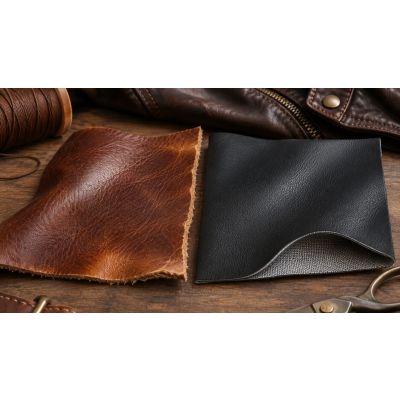
Short answer: Real leather usually lasts longer, breathes better and can be repaired. Vegan and PU leather cost less up front but tend to crack or peel sooner. Compare cost per year of use, not just the price tag, and choose the material that matches how you will wear the jacket.
Quick comparison
| Material | Lifespan | Breathability | Repair | Feel | Upfront cost |
|---|---|---|---|---|---|
| Real full-grain leather | Longest, with care | Good | Often repairable | Develops character | Higher |
| Bonded leather | Short | Poor | Rarely | Uniform, can feel stiff | Low to mid |
| PU (polyurethane) | Short to medium | Poor | Rarely | Smooth, can feel plasticky | Low |
| Plant-based or mixed "vegan" | Varies widely | Varies | Rarely | Varies | Low to high |
These are general patterns. A well-made faux jacket can outlast a poor leather one, and quality varies inside every category.
What each material is
- Real full-grain leather: the outer layer of an animal hide, with its natural grain. It is a single fibrous material.
- Bonded leather: scraps of leather fibers glued to a backing, with a surface coating.
- PU leather: a polyurethane coating over a fabric base.
- Vegan leather: a label for any non-animal material. It is not a quality grade. It can mean PU, PVC or a plant-based material such as one made from fruit, cork or other plant sources. These differ a lot in durability.
Terms such as "faux leather" and "leatherette" usually mean PU or PVC. For how to check what you are buying, see how to tell real leather from fake, and for real leather grades, full-grain vs top-grain leather.
Lifespan and peeling
Coated materials fail through the coating. The surface film separates from its backing and flakes or cracks. Once it begins, it does not stop. Real leather ages differently: it creases, softens and darkens, and damage stays in the hide. A well-cared-for leather jacket can look better after years of wear. We do not give a number of years, because the figure depends on the leather, the build and the care.
Plant-based materials are newer, and their long-term track record is shorter, so be cautious with lifespan claims from sellers. Read why is my leather jacket peeling? for how the failure looks and how to check your own jacket.
Comfort and breathability
Real leather is made of fibers that allow some air and moisture movement, which makes it more comfortable in changing temperatures. Plastic coatings do not breathe, so a faux jacket can feel clammy when you are active or in warm weather. In cold weather, faux jackets can feel stiff. For riding, comfort also depends on fit and lining.
Repair and care
Real leather can be cleaned, conditioned, patched, re-dyed and restitched. A specialist can often extend its life. Coated materials generally cannot be re-bonded once the coating fails, so repairs are temporary. For real leather upkeep, see how to care for leather gear and the DIY leather repair guide.
Cost per year: a worksheet
A low price looks attractive, but what matters is the cost of each year you wear the jacket. Use your own prices and your own honest estimate of how long you will keep each.
| Step | Jacket A (faux) | Jacket B (real leather) |
|---|---|---|
| 1. Purchase price | ||
| 2. Years you expect to wear it | ||
| 3. Repair or care costs over that time | ||
| 4. Total cost (1 + 3) | ||
| 5. Cost per year (4 divided by 2) |
Be honest about step 2. If you replace a faux jacket every two seasons, use two. If you have a real leather jacket that is still going after many years, count the years you have actually had. The result will show whether the higher price pays back. We give no sample figures, because they would be invented.
Environmental and ethical questions
People choose vegan leather for ethical reasons, and that is a valid reason. The environmental picture is harder to state, because the impacts depend on how each material is made, how long it lasts and what happens to it afterward. Claims on both sides are often broad. We make no claim here. If this matters to you, look at independent life-cycle assessments and certification bodies, and ask sellers for specifics. Our article on sustainable leather and how we source responsibly explains our own approach.
How to judge a faux jacket before you buy
If you decide on faux or plant-based, choose carefully. Look for the exact material named on the label, not just the word "vegan". Check whether the base is woven or knit, since a stronger backing holds the coating better. Read reviews that were written after months of use, not days. Check how the seller handles returns if it fails early. And look at how the edges and seams are finished: coating that is already lifting at the hem in the product photo is a bad sign.
How to judge a real leather jacket before you buy
The same care applies in the other direction. "Leather" on a label does not mean a high-quality hide. Ask what type it is: full-grain, top-grain, split or bonded. Check the cut edge for fibers. Look at the stitching and the lining, since a good hide in a poor build will still fail. And confirm that the product page says what the jacket is made from. Leather Collection product pages name the leather and its thickness. A seller that makes real leather jackets should be able to tell you.
Common myths on both sides
- "Vegan leather is always cheaper to own." Not if it is replaced every couple of seasons.
- "Real leather is always better." Not if it is bonded or poorly built, or if it is chosen for a use it does not suit.
- "Vegan means plant-based." Often it means PU or PVC, which are plastics.
- "Faux leather is easy to repair." Patches and fillers are temporary, because the coating keeps lifting.
- "Real leather needs constant care." It benefits from occasional cleaning and conditioning, but not constant attention.
When faux is a fair choice
This comparison is not an argument that faux is always wrong. It suits a short-term fashion purchase, a budget that cannot stretch to leather, a costume or a piece you do not expect to keep. It suits those who do not want animal products, as long as they check quality. The point is to choose it knowingly, with a realistic view of how long it will last, rather than expecting it to behave like leather.
Which to choose
| Your priority | Better fit |
|---|---|
| Riding | Real leather built for riding, or textile with armor; not a fashion faux jacket |
| Long-term wear and repair | Real full-grain leather |
| Tight budget, short-term use | Faux can make sense |
| Avoiding animal products | Choose a faux or plant-based material and look for evidence of quality |
| Fashion item for one season | Faux is a reasonable choice |
For motorcycles, the question is about protection as well as comfort. See leather vs textile motorcycle jackets. Faux leather is not designed for abrasion in a crash, and no fashion jacket should be treated as riding gear.
FAQs
Is vegan leather better than real leather?
It depends on what you need. Real leather lasts longer and can be repaired. Vegan leather avoids animal products and is usually cheaper up front.
Does vegan leather last as long as real leather?
Usually not. Coated materials tend to crack or peel sooner. Plant-based materials vary and have a shorter track record.
Why does faux leather peel?
The surface coating separates from its backing because of flexing, heat, sweat and age. Once it starts, it spreads.
Is PU leather real leather?
No. PU is a polyurethane coating, not an animal hide.
Can you ride in a vegan leather jacket?
Not safely, unless it is built and certified for riding. Most vegan fashion jackets offer little protection in a slide.
If you want leather that lasts, see custom leather jackets or men's leather clothing.