 USA
USA  Brazil
  Germany
  France
  Italy
Italy  Switzerland
  Sweden
  Spain
Spain  Great Britain
  Norway
  Russia
  South Africa
  Japan
Japan  New Zealand
  Australia
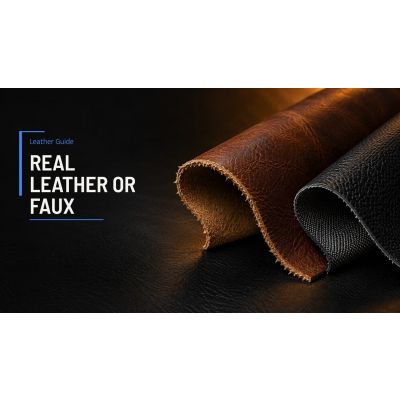
To authenticate leather pants before buying, read the material label and the seller's description first, then check the places where the material shows its structure: cut edges, the inside of the waistband and hems, and the underside of the surface. Real leather is made from animal hide, while imitation leather is a coating on a fabric base. No single quick test is conclusive, so combine several checks. This guide sticks to checks that hold up and leaves out folk tests that can damage the garment.
Key Takeaways
- The material label and the written product description are the first evidence; vague words such as leather look or faux point to a synthetic.
- Genuine leather is a loose term, so ask which grain type and finish the pants use.
- Cut edges and the underside often show a fibrous structure in leather and may show a fabric backing in artificial leather.
- A uniform grain pattern proves nothing, because grain can be embossed onto corrected leather and onto imitation materials.
- Skip burn, water and scratch tests on pants you plan to wear.
Start With the Label and Description
The label is the cheapest and most reliable first check. In the United States, the Federal Trade Commission's leather guides say the unqualified word leather should describe only a product composed in all substantial parts of leather, and that non-leather material which looks like leather should be disclosed as such (16 CFR Part 24). Other regions word their rules differently, but the habit is the same: read what the label actually says rather than what the photos suggest.
Look for specific wording such as cowhide, lambskin or goatskin, and treat these phrases as warning signs:
- Leather look, leatherette, vegan leather, PU or PVC: these describe synthetic coatings.
- Man-made material or polyester listed for the shell or outer layer: the outer surface is not hide (linings are labeled separately).
- Bonded or reconstituted leather: a composite, discussed below.
- No material information at all: a reason to ask before buying.
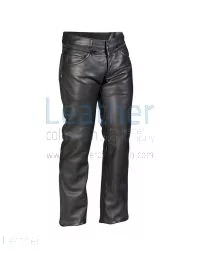
For men's pants, a listing worth trusting names the animal and the leather type, and shows close-ups of seams and the interior. The category is an example of how a product range can be organized by garment type, and each product page should be read for its own material description.
What "Genuine Leather" Really Means
Many shoppers read genuine leather as a mark of quality. It is not. Wikipedia's article on leather notes that the term lacks a standardized meaning, that it often indicates split leather that has been extensively processed, and that rules for using it on labels vary by jurisdiction. In other words, it tells you the material is leather, not which part of the hide it came from.
The same source separates the main types. Full-grain leather keeps the entire grain layer with no removal of the surface. Top-grain includes the outer grain layer. Corrected grain has had flaws buffed or sanded away, then been dyed and embossed. Split leather comes from the fibrous layer beneath the grain. A seller who can say which of these applies is giving you more information than one who only writes genuine.
For pants the type matters less than an honest description, so ask which leather type and finish applies. The point is to know what you are buying, not to rank one type above another for every wearer.
Check the Edges and the Underside
Leather is skin, so it has a fibrous structure. Wikipedia describes the layer beneath the grain as the fibrous corium. Artificial leather is built differently: the usual method applies a polyurethane or PVC coating, a colour coat and a textured finish to a base fabric, using embossed release paper to mimic the look of leather. That difference shows where the material is cut or turned back.
| Where to look | Real leather | Artificial leather |
|---|---|---|
| Cut edge, such as inside a hem or waistband | Often a fibrous edge of one continuous material | May show a fabric layer under a coating |
| Underside of the panel | Often a suede-like or fibrous texture | May show a woven or knitted fabric, sometimes polyester |
| Surface close up | May show small natural irregularities, which vary | Pattern may repeat closely because it is embossed |
| Label or description | Names the hide or leather type | Says synthetic, PU, PVC or faux |
Be careful with lined pants. A lining is a separate fabric stitched inside the garment, so seeing fabric inside is not a red flag by itself. What you want to find is a spot, such as an unfinished seam allowance or a turned hem, where the actual outer material is visible from behind.
Why Grain Pattern Alone Proves Nothing
A common piece of advice is to look for irregular pores and uneven grain. This helps a little, but it can mislead in both directions. Corrected grain leather is sanded and embossed, so it can look very even while still being real leather. Meanwhile, synthetic materials are produced against embossed release paper specifically to copy a grain texture. An extremely regular pattern across the whole panel is a reason to read the description more closely, not a verdict.
Smell and feel follow the same logic. Finishing, dyeing and coatings change both, so a leather garment can feel smooth and smell faintly of chemicals, and a synthetic can be made to feel soft. Treat them as supporting impressions at most.
Watch for Bonded and Composite Materials
Bonded leather sits between the two categories. Wikipedia describes it as shredded leather fibres mixed with natural rubber or polyurethane binders, layered onto a cloth or paper backing and embossed with a leather-like texture. The FTC guides call for a disclosure of the percentages of leather fibres and non-leather substances when terms such as bonded leather or reconstituted leather are used. If a listing uses that term without any proportion, ask for it.
Bonded material appears in many product types, so check the label wherever the term is used and do not mistake it for a hide.
Tests to Skip on Pants You Plan to Wear
Burn tests, water-drop tests and scratching with a fingernail circulate widely, but none of them is a reliable, safe test on a finished garment, and they can leave permanent marks. Prefer checks that do not touch the surface: the label, the written description, a close look at edges and seams, and a direct question to the seller.
Questions to Ask Before You Order
- Which animal and which leather type are the pants made from?
- Is the surface finished, coated or embossed?
- Is there a lining, and what is it made of?
- Can you see close-up photos of the hem, waistband and seams?
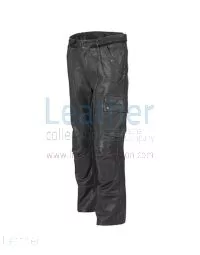
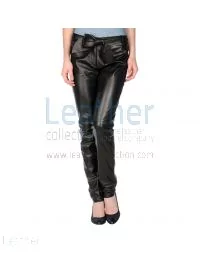
Clear answers are a good sign. Each product page should describe its own material, whether it is a style such as the or a straight-leg cut like the , and the broader range works the same way. The same questions apply to the .
If the answers are evasive, or the description only says leather look, treat the item as synthetic and judge it on that basis.
Frequently Asked Questions
Does the word genuine leather on a label mean full-grain?
No. The word genuine only says the material is leather. According to Wikipedia's leather article, the term lacks a standardized meaning and often points to split leather that has been heavily processed. Full-grain, top-grain and corrected grain describe how the surface was treated, so ask the seller which one applies to the pants in question.
Can I tell real leather from fake using only photos?
Photos help, but they rarely settle the question. Embossed grain can look uniform and convincing on screen. Look for a clear material description, close-ups of seams, hems and the inside of the waistband, and a seller willing to name the leather type and finish. If the listing only says leather look or vegan, treat it as a synthetic.
Is bonded leather real leather?
Partly. Bonded leather is made from shredded leather fibres mixed with binders and layered onto a backing, then embossed with a grain pattern. It contains leather but is a different material from a hide. A label that names bonded leather should come with the proportion of leather fibres, as the FTC leather guides call for.
Are leather pants with a fabric back always fake?
Not necessarily. Many real leather garments carry a separate lining, so a fabric layer inside the pants is normal. The difference is where the fabric sits: a lining is stitched in as its own layer, while an artificial leather has its fabric backing fused directly to the coating. Check exposed edges inside the hem or waistband.
Written by the Leather Collection Editorial Team.