 USA
 Brazil
 Germany
 France
 Italy
 Switzerland
 Sweden
 Spain
 Great Britain
 Norway
 Russia
 South Africa
 Japan
 New Zealand
 Australia

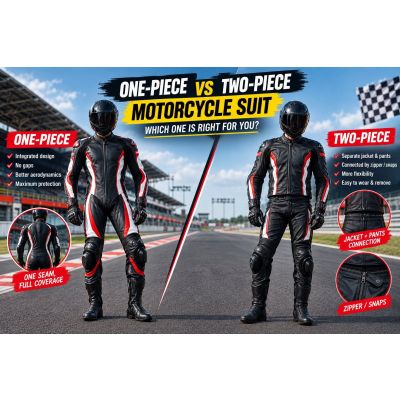
Track riders face a basic gear decision before the first session: a one-piece leather suit or a two-piece suit. The choice affects protection, comfort, mobility and how practical the gear is off the bike. Understanding the real differences helps a rider decide on riding style, track experience and personal priorities rather than assumptions or brand loyalty.
Both options serve serious riders, but they excel in different situations. A one-piece suit offers an integrated garment with a single fit. A two-piece setup provides flexibility, easier removal between sessions and more versatility off the circuit. Neither is universally better, and the right choice depends on whether the priority is pure track use or gear that also works on the road.
Key Takeaways
- A one-piece suit is a single garment with no join between jacket and pants; a two-piece suit is a jacket and pants that connect with a zip.
- Protection depends more on the EN 17092 class, the EN 1621 armour level, fit and armour placement than on the suit style.
- One-piece suits suit track-only riders; two-piece suits are more practical for mixed street and track use.
- Fit in the riding position matters more than the suit configuration.
- Both types should be inspected after any crash.
Quick Comparison Answer
A one-piece suit is the usual choice for riders who mostly ride on track, want continuous coverage with no join between jacket and pants and stay on the bike for whole sessions. A two-piece suit suits riders who split their time between street and track, step off the bike often and want pieces that can be worn separately. The decision should weigh track time, fit in the riding position, armour coverage, certification labels and whether the gear has to work off the motorcycle.
What Is the Main Difference Between One-Piece and Two-Piece Motorcycle Leathers?
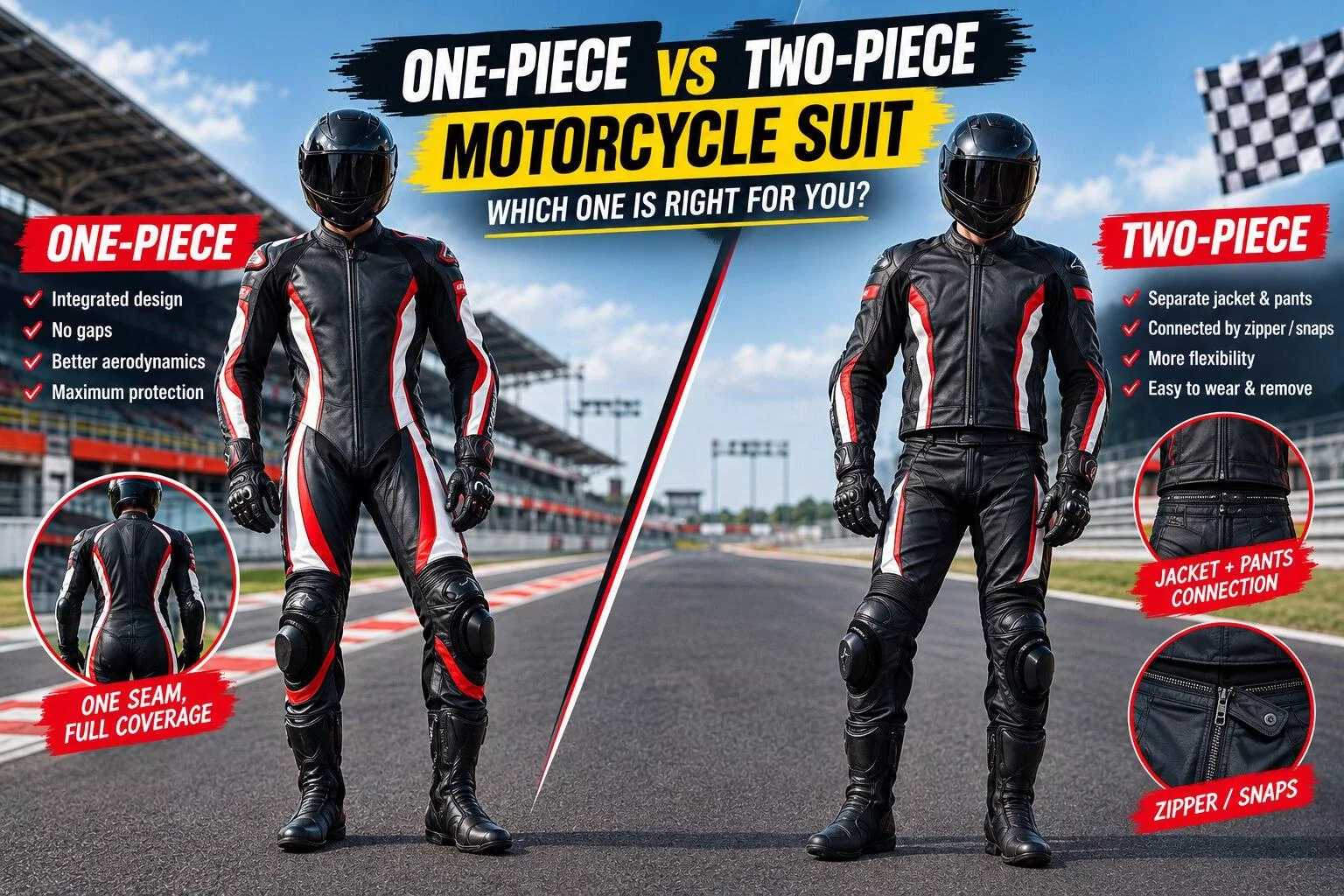
The core difference is structural. A one-piece suit is a single garment that covers torso, arms and legs. A two-piece suit is a jacket and pants that connect with a zipper or snap system and can be separated.
One-piece suits are designed around the riding position, with panels and stretch zones placed to move with a seated rider. There is no join between jacket and pants, so abrasion coverage stays continuous even during aggressive movement or a slide.
Two-piece suits offer separate components. They can be worn together as a set or separately for different riding situations. The connection is secure when zipped or snapped, but the design allows easier removal and adjustment, which suits riders who need to step off the bike often.
Which Option Offers Better Track Rider Protection?
Protection depends more on material quality, armour specification, fit and certification than on whether the suit is one piece or two. Both options can give strong coverage when constructed and fitted properly.
A one-piece suit has no gap between jacket and pants. Abrasion coverage runs across the body without a join. The riding-position fit is cut into the suit, so armour is usually placed for a seated posture.
A two-piece suit can also protect well, but the quality of the connection matters. A secure connection is meant to keep the pieces together, but EN 17092 only tests two-piece engagement with a static load, so crash performance of the zip is not established by the label. If the fit is poor or the connection loosens, gaps can open, and armour can shift if the jacket and pants do not align.
The real protection comparison rests on material thickness and quality, armour type and placement, the EN 17092 garment class, EN 1621 armour certification, fit in the riding position and whether the armour stays positioned during movement and braking. Both styles can meet high standards; the difference is construction and fit, not the style itself.
Impact Protection and Armour Standards
The garment standard is EN 17092. According to SATRA's overview of EN 17092, it defines five classes, AAA, AA, A, B and C, with AAA offering the highest level of protection from impact and abrasion. The standard splits a garment into three risk zones and tests abrasion on a Darmstadt machine, where a hole of 5 mm or more is a failure; tear strength and seam performance are tested too.
Armour is tested separately. As SATRA explains, EN 17092 refers to the relevant part of EN 1621 for protectors. Under EN 1621-1, Level 1 limb protectors must have a mean transmitted force below 35 kN (no single value over 50 kN) and Level 2 below 20 kN. Armour that stays over the knees, hips, elbows and shoulders while seated and braking matters more than the suit style, and poor fit or a loose connection can compromise protection in either type.
Which Option Feels More Comfortable on the Bike?
Comfort depends on fit, material flexibility and how the suit accommodates the riding position. Both can be comfortable when properly sized.
One-piece suits are engineered around the riding position, with panels, stretch zones and seam placement designed to move with a seated rider. Many riders find the garment feels integrated because there is no connection to think about and no transition between jacket and pants. For track riding, where a rider stays on the bike through long sessions, that unified fit often feels natural.
Two-piece suits offer other advantages. Jacket and pants can be fitted independently, which helps when torso and leg proportions differ. The jacket can be taken off between sessions, and walking in the paddock is easier. On the bike, comfort depends on how well the pieces align; a poor connection or mismatched fit can bunch or restrict.
The deciding factor is fit tested in the riding position, seated with hands on the bars and the body in a full tuck. If the suit restricts movement, pulls at the shoulders or lets armour shift, it is not comfortable for track use in either style.
Which Option Is Better for Track-Only Riding?
For riders who focus on track days or racing, a one-piece suit is often the usual choice, for these reasons:
Track riding keeps a rider on the bike for whole sessions, with no need to take gear off between laps. A one-piece suit suits that pattern: continuous coverage, a fit cut for the seated posture, and no connection that can loosen.
The practical limits of a one-piece suit matter less on track. There is no need to remove the jacket between sessions or wear the suit around town, so the focus stays on protection, fit and performance. Riders comparing suits for the circuit can look at .
A well-fitted two-piece suit can still protect well on track. Some experienced riders prefer two-piece gear because the jacket fits independently or can be removed when overheating. The choice comes down to fit and personal preference rather than a fixed difference in protection.
Which Option Works Better for Street and Track Riding?
For riders who use the bike on both street and track, a two-piece suit is usually more practical.
Street riding means stopping at traffic lights, walking to shops and wearing gear off the bike. A two-piece suit lets a rider take off the jacket while keeping the pants on, or the other way round, and step off the bike without feeling overdressed.
Protection depends on the garment class, the armour, the fit and the connection, and no source compares crash performance of the two formats. Some track-day or race organizers set their own suit rules, so those should be checked first. For mixed riding the key is a two-piece set designed for racing, with a secure zip, armour pockets that align when connected and materials meant for fast riding. are a place to start comparing such sets.
One-piece suits can also work for street and track, but they are less convenient off the bike: the whole suit has to come off to take off a jacket, and individual pieces cannot be adjusted if one part feels tight.
The practical choice for mixed riding is a two-piece suit built for track performance, with secure connections, proper armour integration and a fit that works in the riding position on both street and track.
Why Fit and Armour Placement Matter More Than Suit Style
A common mistake is choosing between one-piece and two-piece on style, brand or appearance without checking fit and armour placement. That is backwards.
A poorly fitted suit of either type can protect less than a well-fitted one. If it is too loose, armour shifts during riding and braking. If it is too tight, it restricts movement and tires the rider in long sessions.
The same applies to two-piece suits. A set that fits well but has a loose connection can open gaps in aggressive riding, and a jacket that is too tight with pants that are too loose misaligns armour and coverage. The standard requires that impact protectors sit in the garment so they cover the body part they are meant to protect.
Before choosing, a rider can do the following:
Sit on the bike in full riding position wearing the suit. Arms should move without pulling at the shoulders, and legs should bend at the knees without restriction. Leaning into the normal cornering posture should leave the armour over the knees, hips and elbows. For a two-piece suit, the jacket and pants should stay connected without separating or bunching.
Wear the suit for 15 to 20 minutes in the riding position. Fit problems often show up during extended wear, not in a quick fitting-room check.
Check the certification labels: the EN 17092 class on the garment and the EN 1621 level on the armour, so that the protection level matches the intended riding.
Which Option Is Easier to Repair and Care For?
Long-term value depends on construction, how often the suit is ridden, how it is cared for and whether it needs repair after a crash.
A one-piece suit is a single unit, so a damaged section is repaired in the whole garment rather than by swapping a piece. It has fewer connection points that can wear.
A two-piece suit has separate components. If the jacket is damaged, it is sometimes possible to replace only the jacket and keep the pants. The zip or snap connection is a wear point that may need attention over time.
For both types, follow the maker's care instructions for the leather and armour; the right care depends on the finish and construction. After a crash or slide, both should be inspected by the manufacturer or a qualified specialist, since damage to the leather, seams or armour may not be visible. Minor damage should not be assumed to be safe to ignore.
Pros and Cons of One-Piece and Two-Piece Motorcycle Leathers
One-Piece Motorcycle Leather Suits
Pros:
- Continuous coverage with no join between jacket and pants
- Fit engineered for the riding position and movement
- Armour placement set for the seated posture
- One garment that feels integrated on the bike
- Fewer connection points that can wear or fail
- A natural choice for track-only riding
Cons:
- Less practical off the bike, since the whole suit has to come off
- Harder to fit when torso and leg proportions differ
- Repairs affect the whole garment
- Breaks and pit-stop adjustments mean removing the suit
- Less flexible for mixed street and track riding
Two-Piece Motorcycle Racing Suits
Pros:
- Practical for street and track, since the jacket can be removed separately
- Jacket and pants can be fitted independently
- Individual pieces can sometimes be replaced if damaged
- More convenient for pit stops and walking around
- Pieces can be worn in different combinations
Cons:
- A gap can open between jacket and pants if the connection loosens
- Armour placement depends on how well the pieces align when connected
- The zip or snap connection is a wear point
- Fit has to be checked in both pieces and when connected
- Protection depends on the connection staying closed during riding
Common Comparison Mistakes Riders Should Avoid
Mistake 1: Choosing on style alone. A one-piece suit can look more racing-focused and a two-piece more practical, but fit, protection and riding use should come first.
Mistake 2: Assuming one-piece suits are always better protected. One-piece suits are not automatically safer. A poorly fitted suit of either type can protect less than a well-fitted one.
Mistake 3: Ignoring armour certification. The garment class (EN 17092) and the armour level (EN 1621) describe different things. Both should be checked on the labels.
Mistake 4: Not checking fit in the riding position. A quick fitting-room visit is not enough. Sitting on the bike, leaning into corners and checking armour placement shows whether the suit restricts movement or lets armour shift.
Mistake 5: Choosing a two-piece suit with a weak connection. Zip systems differ. A two-piece set for track use needs a connection designed for racing and tested before committing to the gear.
Mistake 6: Assuming a higher price means more protection. Construction, certification and fit say more about protection than price does. Compare labels and details.
Mistake 7: Forgetting the rest of the gear. Hands and feet are vulnerable in a crash. The suit is part of a system that also includes gloves, boots and a back protector.
Mistake 8: Not inspecting gear after a crash. Damage to leather, seams, armour or armour pockets may not be visible from outside. A specialist or the manufacturer should check the gear.
Which Option Should a Rider Choose?
A One-Piece Suit Suits Riders When:
- Track riding and racing is the main use
- Continuous coverage with no join between jacket and pants is the priority
- The rider stays on the bike for whole sessions
- Armour placement set for the riding position matters most
- Taking off the whole suit when stepping off the bike is acceptable
A Two-Piece Suit Suits Riders When:
- The rider uses both street and track
- Pit stops or stepping off the bike are frequent
- Torso and legs need independent fitting
- The jacket should come off without removing the pants
- Replacing individual pieces matters
Reconsider Either Option If:
- The choice is based only on appearance
- The fit has not been tested in the riding position
- The suit has no EN 17092 class and the armour has no EN 1621 marking
- The armour does not stay over the knees and hips when seated
- The connection on a two-piece suit feels loose
Final Advice
The choice should rest on riding style, track frequency, fit and protection needs, not on assumptions about which style is better. A one-piece suit gives continuous coverage and is geared to track riding; a two-piece suit offers flexibility for riders on street and track. Both can protect well when they are properly constructed, labeled and fitted to the body and riding position.
Useful questions before deciding: Is the riding mostly on track or mixed? How important is use off the bike? Do jacket and pants need independent fitting? Can the fit be tested in the riding position before buying?
Riders who want to compare protective suits can browse
for racing suits and protective garments, and for the wider range.The
is one example to examine for armour placement, construction and fit. Whichever style is chosen, checking the EN 17092 class and EN 1621 level, testing fit in the riding position and inspecting the gear regularly matter more than the suit configuration.Frequently Asked Questions
Are one-piece suits better protected than two-piece suits?
Not automatically. Both can protect well when they carry an EN 17092 class, use EN 1621 armour and fit correctly. A poorly fitted suit of either type can protect less than a well-fitted one. The difference lies in fit, construction, armour certification and armour placement, so fit should be tested on the bike before deciding.
Can a two-piece racing suit be worn separately on the street?
Yes, many riders wear the jacket and pants separately for street riding. Separated pieces do not give the same continuous coverage as the connected set, though, so full protection means wearing them zipped together. Each piece should be suitable for standalone use, and the rest of the body still needs suitable protective gear.
Is custom sizing worth considering for either style?
It can be, especially for riders with unusual proportions such as a long torso and short legs. Two-piece suits allow the jacket and pants to be sized independently. One-piece suits need more precise sizing, so made-to-measure options may help when standard sizes do not fit in the riding position.
What should be checked on the label before buying?
The label should show the EN 17092 class of the garment, which covers abrasion, tear and seam performance. The armour should carry an EN 1621 marking and a Level 1 or Level 2 rating. Details on armour placement, materials and care are also worth reading before choosing a suit.
Do armour pockets matter in a leather suit?
Yes. Pockets designed into the suit hold the armour where it should be. Aftermarket armour added later can fit less well and move during riding. A suit with factory-integrated pockets for EN 1621 armour is the more reliable base, and the pockets should sit over the knees, hips, elbows and shoulders in the riding position.
Written by the Leather Collection Editorial Team.