 USA
 Brazil
 Germany
 France
 Italy
 Switzerland
 Sweden
 Spain
 Great Britain
 Norway
 Russia
 South Africa
 Japan
 New Zealand
 Australia


The aerodynamic hump is the raised section on the back of many racing suits, most visible on MotoGP riders. It is an aerodynamic design feature, and it is easy to confuse with a protection feature. This guide explains what the hump does, what it does not do, and how to judge a racing suit by its real protection.
Key Takeaways
- The hump is an aerodynamic feature, introduced to reduce the drag created by a rider tucked over the handlebars.
- It is not a protection rating. Protection comes from abrasion-resistant material, impact protectors and fit.
- EN 17092 classes whole garments (AAA, AA, A, B, C), and EN 1621 tests the protectors fitted in them.
- Try a suit on in a tucked riding position, with the helmet, before judging how the hump fits.
Quick Answer
The aerodynamic hump smooths the airflow behind the rider's helmet at speed. It is designed for a tucked riding position. Its job is aerodynamics, not impact protection, so the protection of a suit should be judged by its leather or textile, its protectors and its fit.
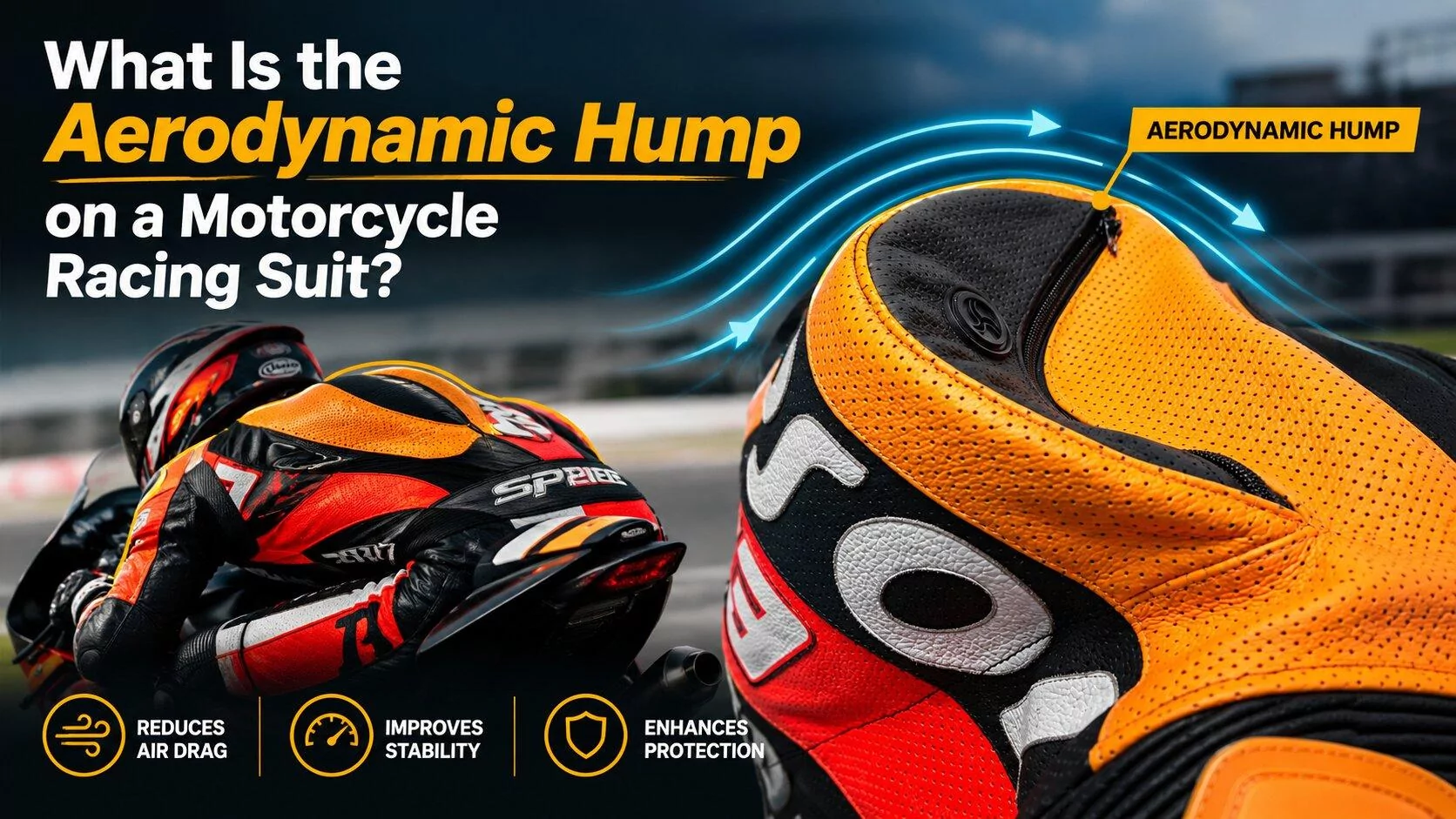
Table of Contents
- What the Aerodynamic Hump Is
- The Hump and Protection
- Standards That Describe Protection
- Fit, Position and the Hump
- What to Check When Choosing a Racing Suit
- Common Mistakes
- FAQs
What the Aerodynamic Hump Is
The hump is a raised, contoured section at the top of the back, behind the helmet. It is built into the suit pattern and is designed to manage how air flows around the rider at speed.
MotoGP's explanation of why riders wear leathers says the hump was originally invented to reduce the aerodynamic drag created by the rider as they tuck down over the handlebars.
The same reasoning applies to production suits: a hump is a styling and aerodynamic choice tied to a tucked position, and its size and shape differ between suit designs.
The Hump and Protection
The hump is not rated for protection. Protection depends on three separate things:
- Abrasion resistance of the outer leather or textile and its seams
- Impact protectors at the shoulders, elbows, hips, knees and back
- Fit, which keeps the protectors over the areas they cover
Airbag vests are now a standard feature integrated into MotoGP riders' leathers, protecting areas such as the chest, shoulders, ribcage, upper back and neck. These are separate systems, and the hump should not be treated as a substitute for any of them.
Standards That Describe Protection
EN 17092 classifies complete motorcycle garments. Classes AAA, AA and A cover abrasion protection with impact protectors, class B has the abrasion performance of class A without protectors, and class C covers impact protectors only. In AAA and AA garments, elbow, shoulder, knee and hip protectors are mandatory.
The protectors are tested to EN 1621. Wikipedia's overview of motorcycle armour gives the limits: limb protectors (EN 1621-1) must average below 35 kN at Level 1 and below 20 kN at Level 2, and back protectors (EN 1621-2) an average below 18 kN at Level 1 and 9 kN at Level 2, with single impacts under 24 kN and 12 kN. A lower figure means less force reaches the body in the test.
Fit, Position and the Hump
Because the hump is designed for a tucked posture, a suit with a pronounced hump can feel different when the rider sits upright. Fabric may pull across the shoulders and neck, or sit away from the back. A suit cut for a different riding position can bunch when the rider leans forward.
Fit also decides whether armour sits where it should. Riders between sizes, or with a longer or shorter torso, can look at made-to-measure options. Leather Collection makes hand-stitched race suits to order from the customer's measurements, and its and categories show suits inspired by the riders and teams of the grid.
What to Check When Choosing a Racing Suit
- Try it in position. Lean forward as if on the bike, with the helmet on, and check how the hump sits behind it.
- Look at the material. Check the leather or textile around the shoulders and back, and look for even seams.
- Ask about protectors. Which protectors are included, where they sit and which EN 1621 level they meet.
- Check the garment class. Look for a stated EN 17092 class if the suit is for road use.
- Match the use. A track suit and a street suit are cut differently. Riders can compare options in the category, such as .
Common Mistakes
- Assuming a bigger hump means more protection. Its purpose is airflow, not impact absorption.
- Buying for looks. A suit that looks right but fits badly can leave protectors out of position.
- Not checking the protectors. A well-shaped hump says nothing about whether armour is present or what level it meets.
- Treating the hump as track-only. It is designed for a tucked position, which also applies to sport riding on the road.
Frequently Asked Questions
Does the aerodynamic hump protect the spine?
No, the hump is an aerodynamic feature, not a protector. Spinal protection comes from a back protector tested to EN 1621-2 at Level 1 or Level 2, together with abrasion-resistant material and a fit that keeps the protector in place. Check the protector rather than the hump.
Why do some racing suits have bigger humps than others?
Production suits differ between designs and riding positions. The size of a hump says nothing about protection, so choose a suit by fit, material and protectors, and check the product page and the garment label for the protectors and class the suit actually lists.
Is the aerodynamic hump required by a safety standard?
The standards discussed here, EN 17092 for garment classes and EN 1621 for protectors, describe abrasion and impact protection, not humps. A hump is a design choice. Check the garment class and protector level instead of the hump when comparing suits.
Can a suit with a hump be comfortable for upright riding?
It depends on the cut. A hump is designed for a tucked posture, so a suit with a pronounced one may pull at the shoulders when the rider sits upright. Try the suit in a normal riding position before buying, or ask about made-to-measure options.
Written by the Leather Collection Editorial Team.