 USA
USA  Brazil
  Germany
  France
  Italy
Italy  Switzerland
  Sweden
  Spain
Spain  Great Britain
  Norway
  Russia
  South Africa
  Japan
Japan  New Zealand
  Australia
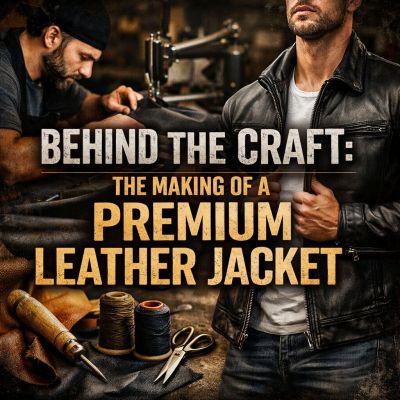
A leather jacket can look similar on a hanger whether it was made carefully or quickly, but the way it is made shows up in how it fits, ages and holds its seams. This guide follows a leather jacket from hide selection to final inspection and explains what each stage changes for the wearer.
Key Takeaways
- Full-grain leather keeps the entire grain layer of the hide, without sanding away the surface.
- Chrome tanning is far faster than vegetable tanning and accounts for most leather produced.
- Cutting around the flaws of each hide and thinning seam edges (skiving) affect how a jacket sits and wears.
- Seams, zippers and linings are the parts that show quality most clearly in daily wear.
Hide Selection: It Starts with the Leather
The leather is the foundation of the jacket, so the process starts with the hide. Surface quality, thickness and consistency all affect how the finished jacket looks and ages.
Understanding Full-Grain Leather
According to Wikipedia, full-grain leather contains the entire grain layer, without any removal of the surface, and develops a patina over its life. Leather whose surface has been sanded or buffed to hide marks is therefore no longer full grain. Practical consequences for a jacket:
Natural surface: markings and grain variation stay visible instead of being sanded away.
Patina: the surface darkens and develops character as it ages.
Consistency: hides chosen for even texture give panels that match across the jacket.
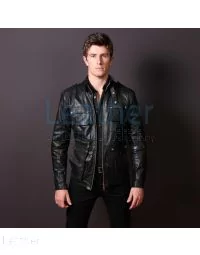
For a soft hand-feel, is one example of a jacket made from selected hides.
The Tanning Process
Tanning is the process that turns raw hide into leather. Two methods dominate:
Vegetable tanning: the oldest known method, using tannins from plant materials such as bark. It takes longer than chrome tanning.
Chrome tanning: a modern method using chromium salts that typically finishes in about a day. It gives softer, more supple, more water-resistant leather and is responsible for 85-90% of modern leather making, as Wikipedia reports.
Chrome-tanned leather therefore dominates jackets where softness and a wide colour range matter, while vegetable-tanned leather suits firmer pieces and develops its patina visibly with age.
Step 1: Pattern and Cutting
Leather is a natural material, and every hide has different stretch zones and flaws. When pieces are cut one hide at a time, the cutter can place each panel to avoid scars and thin areas. Typical decisions include:
Neck wrinkles: usually placed on hidden areas or under the collar.
The spine line: often aligned with the centre back for symmetry.
Scars and marks: kept off the chest and shoulders, where they would be most visible.
Cutting with the grain running the same way across the garment also helps the jacket hang evenly and avoids twisting as it breaks in.
Step 2: Skiving and Preparation
If two thick layers of leather are sewn together without preparation, the seam is bulky and uncomfortable. Skiving solves this by thinning the edges with a machine or a hand tool so they can be folded or overlapped without a lump. It requires care: removing too much weakens the edge. Well-skived seams give a jacket a cleaner outline.
Step 3: Assembly
Sewing leather leaves little room for correction, because every needle hole is permanent. Jackets are sewn on industrial machines with strong needles and bonded thread, and the operator keeps the tension even.
Reinforced seams: areas under stress, such as armholes and pockets, are often double-stitched or backed with tape to stop the leather stretching.
The lining: viscose, cotton or other fabrics are sewn separately and joined to the shell. A smooth lining helps the jacket slide on over layers.
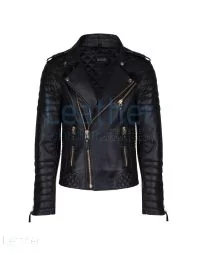
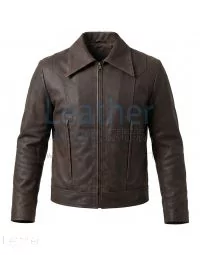
Jackets built on different patterns need different technical approaches, from the multi-panel biker in the to the clean-cut racing styles in . A design with quilted panels, such as , adds extra stitching work.
Step 4: Hardware and Detailing
Hardware is both functional and visible, and plastic zippers on a heavy leather jacket are a weak point.
Zippers: polished metal zippers such as YKK's Excella line, which uses fully polished elements, are a common choice for jackets. They should run smoothly and feel solid.
Snaps and rivets: usually brass or steel, often with an antique or matte finish.
Topstitching: the visible stitching should keep a consistent stitch length and straight lines.
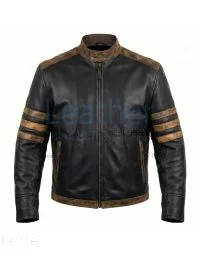
Practical details such as removable parts also depend on good hardware. A shows how zippers become part of the design.
Step 5: Finishing and Quality Control
Before a jacket is packed, a finishing stage may include:
Buffing: to give the leather a subtle sheen.
Waxing: applying waxes to pull-up leathers to add depth of colour.
Inspection: checking each stitch, zipper and snap, and rejecting pieces with loose threads or misaligned fittings.
Why the Construction Matters Over Time
Fit
A jacket that is cut and sewn evenly settles into the shape of the wearer. Creases form at the elbows and shoulders, and the leather softens with use. For a closer fit, the shows how cutting to measurements changes the result.
Care and Longevity
Leather is durable, but the length of service depends on the hide, the construction and maintenance. Occasional conditioning, drying away from direct heat and storage on a wide hanger help the material stay supple.
Character
Small variations in grain and colour make each jacket slightly different, which is a feature of natural material rather than a flaw.
Conclusion
Understanding how a leather jacket is made explains why two jackets of similar styling can feel and age differently. The hide, the tanning method, careful cutting, skived seams, strong stitching and sound hardware are the points worth checking before buying.
Frequently Asked Questions
What does full-grain leather mean?
Full-grain leather contains the entire grain layer of the hide, with no removal of the surface. It keeps its natural markings and develops a patina as it ages. Leather that has been sanded or buffed to hide marks no longer counts as full grain, so a jacket described as full grain should show visible natural variation.
What is the difference between chrome and vegetable tanning?
Vegetable tanning uses plant tannins, is the older method and takes longer than chrome tanning. Chrome tanning uses chromium salts, finishes in about a day and gives softer, more supple leather. Chrome tanning is responsible for 85-90% of modern leather making, so most leather jackets are chrome-tanned.
What is skiving in jacket making?
Skiving is the thinning of leather edges, done by machine or hand tool, so that seams can be folded or overlapped without creating a bulky ridge. It makes seams and collars lie flatter. It needs precision, because thinning the leather too far weakens the edge.
How can the quality of a leather jacket be checked in person?
Look at the evenness of the stitching, whether stress points such as armholes and pockets are reinforced, how the zipper runs and whether the lining is cleanly sewn. Check that the panels match in grain and colour and that seams lie flat without puckering.
Written by the Leather Collection Editorial Team.