 USA
 Brazil
 Germany
 France
 Italy
 Switzerland
 Sweden
 Spain
 Great Britain
 Norway
 Russia
 South Africa
 Japan
 New Zealand
 Australia

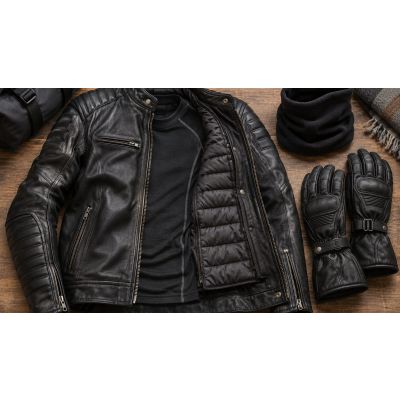
Short answer: Stay warm by blocking the wind first, adding thin insulating layers under the jacket, and protecting your hands, neck and feet. Heated vests and gloves help but need a power source. Check that your layers still leave room for armor and movement.
A leather jacket is good at stopping wind, which is the biggest cause of cold on a motorcycle. It is not good at holding heat on its own. This guide shows how to add warmth without making the jacket tight, and when heated gear is worth it.
Why it feels colder than the forecast
Moving air carries heat away from the body. At riding speed, you are moving through air much faster than a walker, so the effective cold is higher than the air temperature. Weather services publish wind-chill charts that show how air speed and temperature combine, and the US National Weather Service has one on its website. Use a chart from a weather authority rather than a rule of thumb. Our rough point is this: a "cool" morning can feel properly cold at highway speed.
Leather blocks wind well, but it does not insulate much. That is why layers matter.
Layer order under a leather jacket
- Base layer: a thin, close-fitting top that moves moisture away from skin. Merino wool and synthetic fabrics work. Avoid cotton, which stays damp and cold.
- Mid layer: a thin fleece or knit for insulation. Choose thin over thick, because bulk eats the room armor needs.
- Wind layer: your leather jacket. It stops the wind so the layers beneath can hold heat.
What to avoid: loose hoodies with big hoods that bunch up behind the neck, scarves that can flap into the helmet area, and any layer thick enough to push the armor away from your body.
Hands, neck and feet
These areas lose heat fastest and are the first to hurt.
- Hands: gloves with a lining or a pair of thin liners underneath. Make sure the glove still lets you feel the controls. Look at our custom motorcycle gloves for a made-to-fit pair, since a glove that is too tight cuts circulation and makes cold hands worse.
- Neck: a neck gaiter or a collar that seals under the helmet. Cold air at the neck runs down the chest.
- Feet: warm socks, not too thick, and boots with room for them. Tight boots restrict blood flow.
Heated gear
Heated vests, gloves and liners warm the body with a thin wire or panel. They connect to the bike's power, or to a battery. A few things to know:
- Power: check the wattage of the garment against what your bike's electrical system can spare. A heated item draws a measurable load, and some bikes cannot supply much extra. Check the manufacturer's specifications.
- Connection: some use a plug that runs to the battery, others use a battery pack. Make sure the cables do not interfere with the controls.
- Layering: a heated vest works best next to a base layer, under the jacket. It must sit against the body to transfer heat.
- Fit: a heated liner adds bulk. Make sure the jacket still closes comfortably.
We do not make claims about specific heated products or about heated-gear compatibility with our own jackets. See each product page for the lining options on a jacket.
Fit: do not stuff the jacket
A jacket stuffed with thick layers will fit poorly, and a poor fit moves armor away from where it protects. Armor should sit over the joints, so that it does not shift in a fall. A tight jacket also restricts blood flow and traps less warm air than a jacket with a little space.
If you ride in winter regularly, choose a jacket cut for your layers. A made-to-measure jacket can be cut with room for a mid layer. See our custom motorcycle jackets for how that works. Wear your winter layers when you take measurements.
Riding habits for cold
- Start warm. It is harder to warm up on the bike than before you leave.
- Stop every hour or so to stretch and warm hands.
- Drink water. Cold weather hides thirst.
- Slow down when your hands go numb. Reduced feel is a safety issue, not only a comfort one.
- Know when to stop. If you are shivering hard or cannot feel the controls, it is time to stop and warm up.
Quick checklist by temperature range
These bands are rough guides and assume a ride at moderate speed. Adjust for your own tolerance, wind and speed.
| Range | Layers | Extras |
|---|---|---|
| Mild (cool) | Base layer, jacket | Lightly lined gloves |
| Cold | Base layer, thin fleece, jacket | Neck gaiter, warm gloves, warm socks |
| Very cold | Base layer, mid layer, jacket | Heated vest or liner, heated or insulated gloves |
| Near freezing or below | All of the above, plus warm trousers or liners | Check road conditions and consider not riding |
Layering and armor: why bulk matters
Armor works only when it sits where it was designed to sit. In a jacket with shoulder and elbow armor, a thick layer pushes the armor outward and gives it room to slide. A better approach is to choose several thin layers over one thick one, and test them with the jacket on.
A fast test: put on your winter layers, then your jacket. Raise your arms, reach forward as if holding the handlebars, and turn your head. The jacket should not pull across your back or bunch under the armpits. If it does, your layers are too thick or the jacket is too small.
Gloves follow the same rule. A thick glove that fits tightly can make cold worse by restricting blood flow. Choose gloves that fit with room for warm air, or a thin liner and a slightly larger glove.
Common mistakes in cold weather riding
- Wearing cotton next to skin: it holds sweat and gets cold.
- Starting cold: it is hard to recover warmth once you lose it. Warm up the gear indoors before you leave.
- Ignoring the neck: cold air slips down the collar.
- Skipping stops: a short break warms hands and helps you stay alert.
- Using wire or loose cables without care: cables from heated gear should be routed so they cannot catch on controls.
Gear care in winter
Salt and road grime are hard on leather. Wipe the jacket after wet rides and let it dry at room temperature, away from heaters. For more, see our posts on rain and leather, and the general guide on whether leather jackets keep you warm. For styling beyond the bike, see seasonal leather styling and our guide to layering a leather jacket across seasons.
Order a jacket cut with room for winter layers in our custom motorcycle jackets.
FAQs
What do you wear under a leather motorcycle jacket in winter?
A thin base layer and a thin fleece or knit. Add a heated vest in very cold weather. Avoid thick, bulky layers that push the armor out of place.
Are heated gloves worth it?
For many riders in cold weather, yes. Cold hands lose feel for the controls. Check the power draw and connection first.
Do leather jackets keep you warm on a bike?
They block wind well, which helps a lot. They do not insulate by themselves, so add layers underneath.
How cold is too cold to ride?
It depends on your gear, your experience and the road. Ice and snow are the main limit. If you cannot feel the controls, stop.
Can you wear a hoodie under a motorcycle jacket?
You can, but the hood bunches at the neck, and a thick hoodie can crowd the armor. A thin fleece is a better choice.
How do I stop my hands freezing on a motorcycle?
Use lined gloves, thin liners, heated grips or gloves, and keep the wind off your hands with fairings or hand guards if the bike allows. Stop and warm them if they go numb.