The label on motorcycle riding gear can look official, yet the letters A, AA and AAA say little to a first-time buyer. They are protection classes defined by the EN 17092 motorcycle clothing standard, and each one describes how a garment performs when it slides along a road surface.
CE ratings can sound technical, but every class answers a practical question: which tests did this garment meet? This guide explains the EN17092 levels in plain terms, shows how the laboratory tests work, and sets out what each class requires.
Key Takeaways
EN 17092 sorts motorcycle clothing into classes AAA, AA, A, B and C; AAA carries the highest abrasion, tear and seam requirements.
Classes AAA and AA require impact protectors at the shoulders, elbows, hips and knees. The protectors are tested separately under EN 1621.
In the EU, motorcycle clothing is personal protective equipment under Regulation (EU) 2016/425 and has to be CE marked.
Higher classes give more protection but can be heavier and hotter; choose the class that fits how and where you ride, and check the label.
CE stands for Conformité Européenne, meaning “European Conformity.” A CE mark on riding gear shows that the garment was assessed against the relevant European requirements for protective equipment, including abrasion, tear and seam strength.
Before common test methods existed, manufacturers measured gear in their own ways, and riders had no shared yardstick. Under EN 17092, every jacket, pair of pants or suit is measured with the same methods. Since April 2018, motorcycle clothing in the EU falls under Regulation (EU) 2016/425 on personal protective equipment, so it must be CE marked before sale there (MCG product compliance guide).
In short, reading the class and standard on the label gives a comparable minimum test result.
What Is EN17092?
EN 17092 is the European standard for protective garments for motorcycle riders, and the older EN 13595 (professional riders) ran alongside it until its planned withdrawal, March 2023 at the latest. It is published in six parts: part 1 describes the test methods, and parts 2 to 6 set the requirements for classes AAA, AA, A, B and C (SATRA overview of EN 17092).
The laboratory tests simulate crash situations such as sliding on a road surface or seams pulling apart under load. The results decide which class, if any, a garment qualifies for.
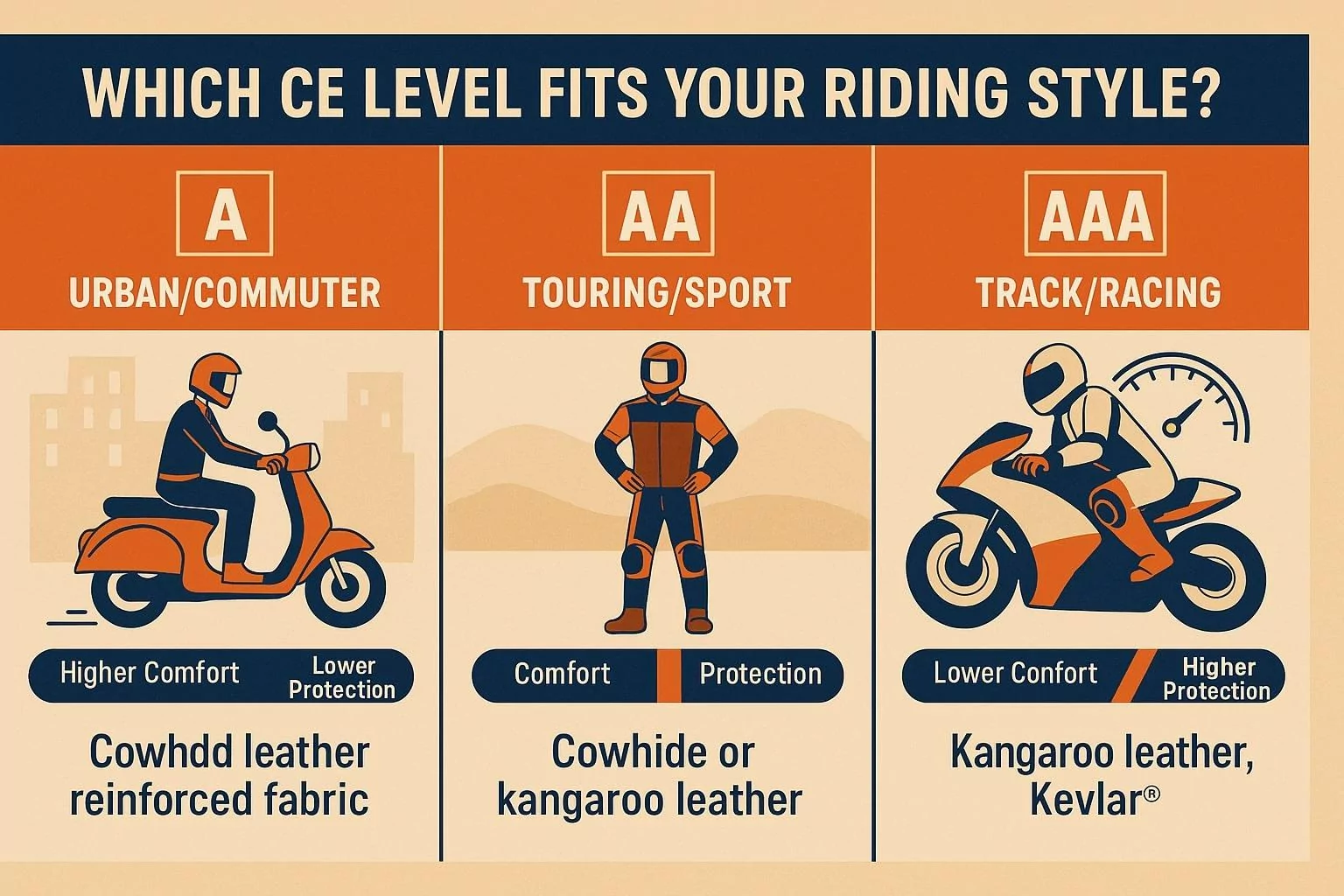
A, AA, and AAA Ratings Explained
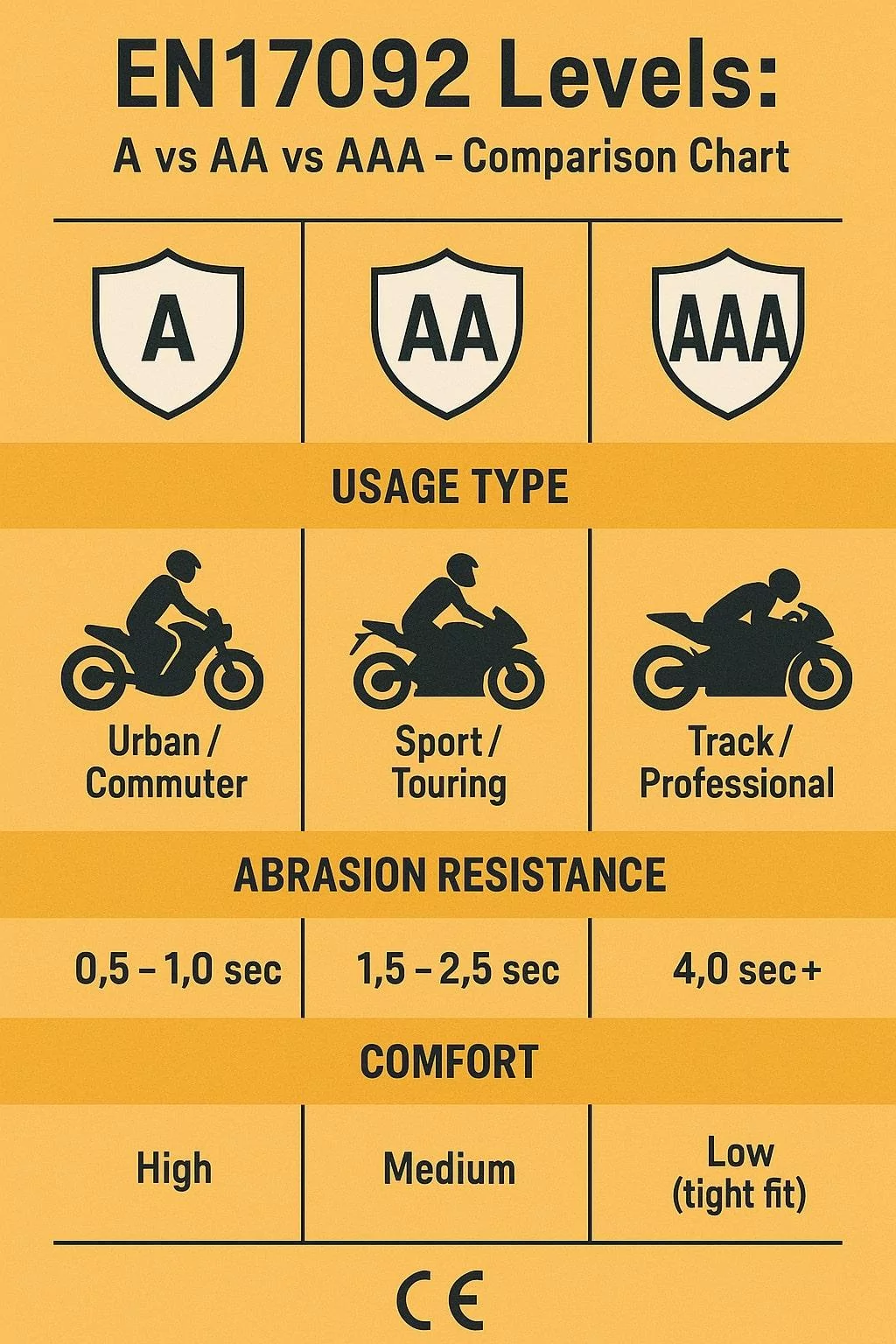
The classes differ mainly in the abrasion requirement for the outer material in the highest-risk zones, such as the shoulders, elbows, hips and knees. The higher the class, the stricter the requirement there (SATRA overview of motorcyclists' PPE testing).
CE Class A
Lowest abrasion requirement of the three.
Impact protectors are required at shoulders, elbows and knees; hip protectors are optional.
CE Class AA
An intermediate abrasion requirement.
Impact protectors are required at shoulders, elbows, hips and knees.
CE Class AAA
The highest requirements: the strictest abrasion test, plus tear and seam strength.
Impact protectors are required at shoulders, elbows, hips and knees.
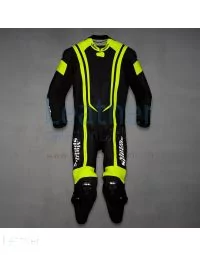
MCG describes this class as covering one- or two-piece leather suits suitable for use on racetracks, the territory of track-day Race Suit
.
Garment classes and armour ratings are separate things: the class describes the outer garment, while the protectors inside are tested under EN 1621.
CE Class
Abrasion Requirement
Impact Protectors Required
A
Lowest
Shoulders, elbows, knees (hips optional)
AA
Intermediate
Shoulders, elbows, hips, knees
AAA
Highest
Shoulders, elbows, hips, knees
How CE Testing Works
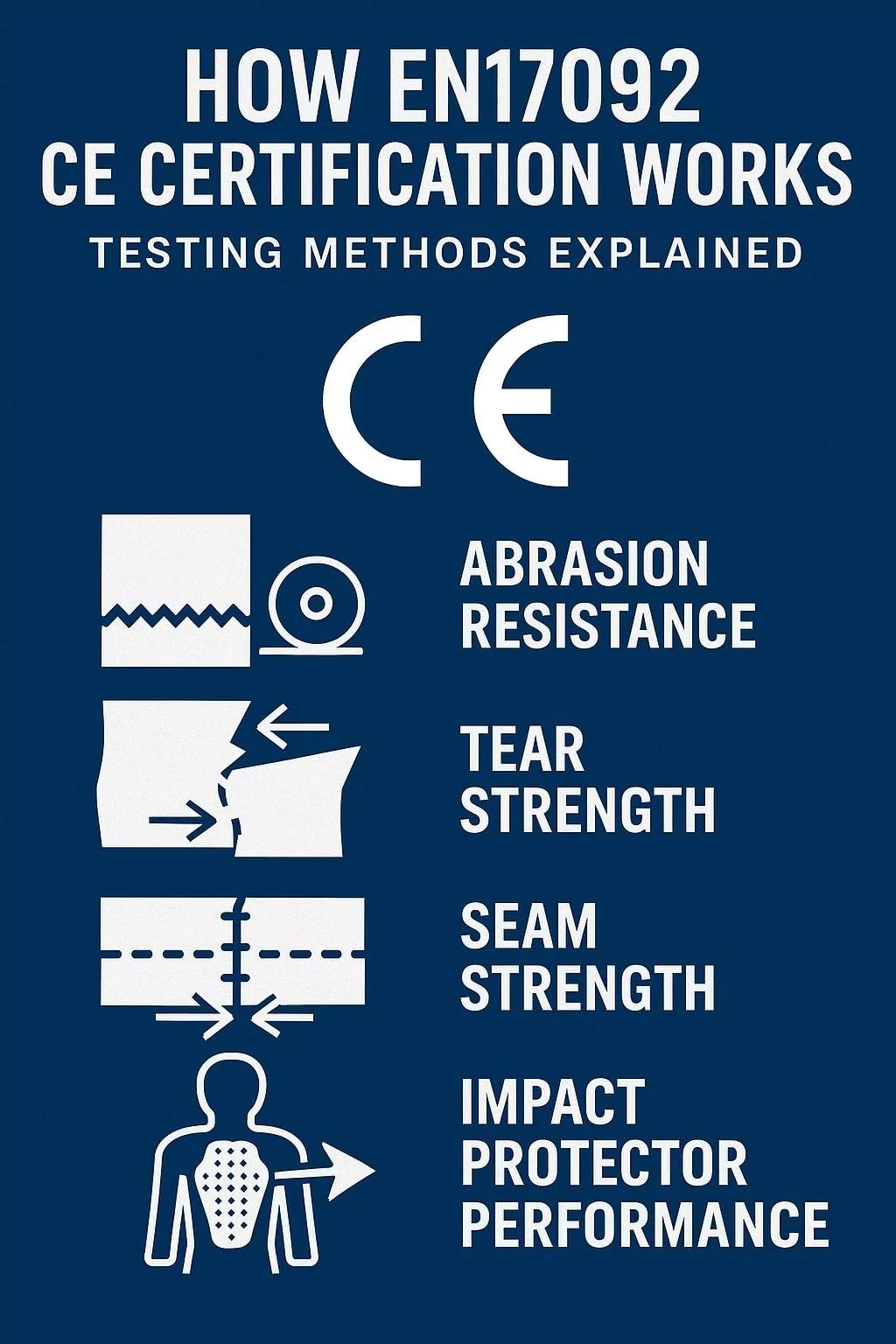
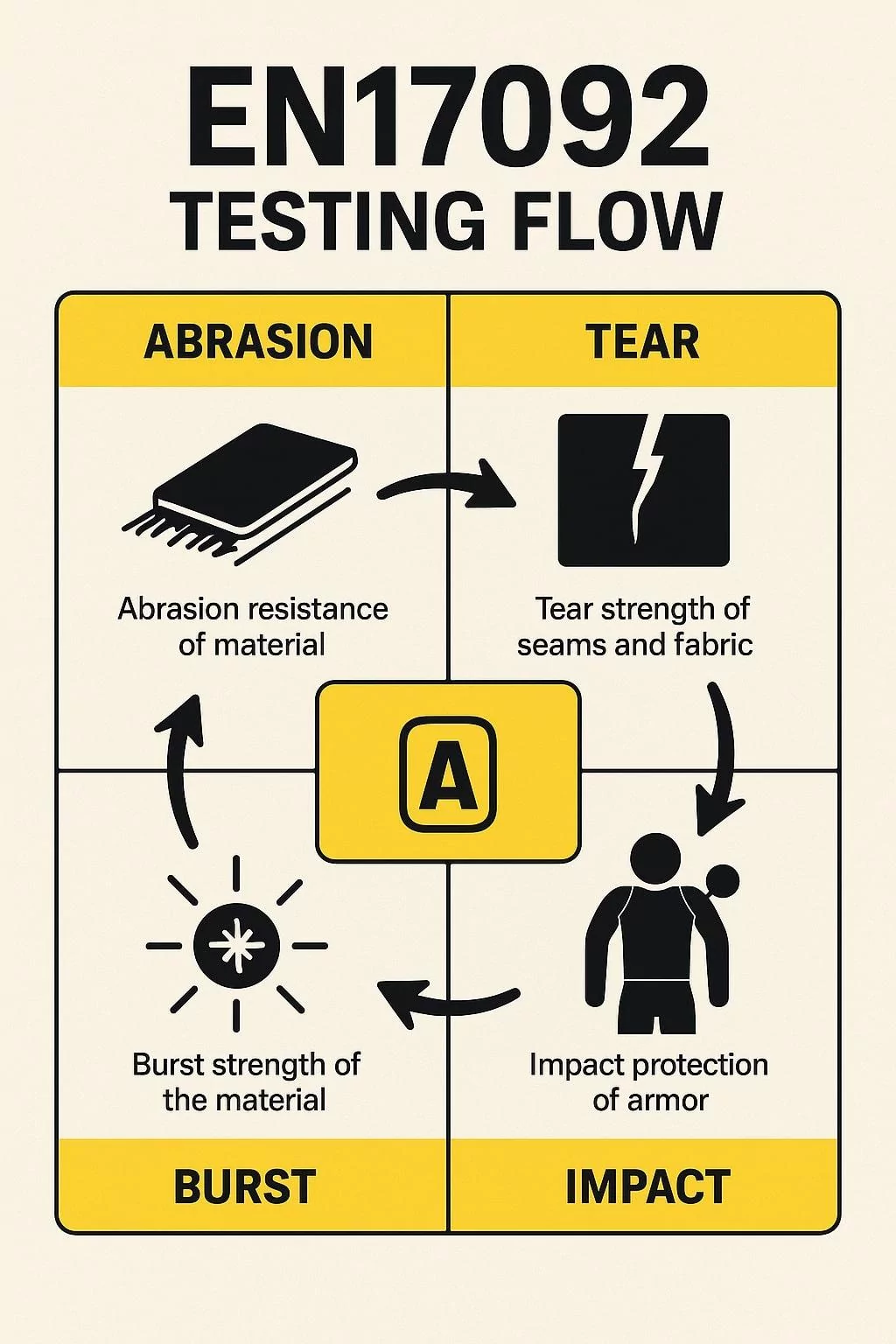
Classification rests on four main laboratory evaluations. Each one reproduces a stress that gear meets in a real accident.
1. Abrasion Resistance Test
Samples are abraded on a Darmstadt machine, which simulates an average rider (75 kg, 1.75 m) sliding on a road surface. The test settings depend on the class and on the garment zone being tested, and a garment must stay intact to meet the class it claims.
2. Tear Strength Test
Samples are clamped and pulled apart to measure how easily they rip under sudden force.
3. Seam Burst Test
Stitched seams are loaded to check that they hold during impact or sliding.
4. Impact Protector Test
The armour pads are tested under EN 1621 for how much force they pass through to the body. Lower transmitted force means better protection, and Level 2 protectors must transmit less force than Level 1.
Choosing the Right CE Level for You
There is no single answer, because the choice balances comfort, mobility and protection. Higher classes give more protection but can be heavier and hotter; choose the class that fits how and where you ride, and check the label.
Reading the Label
The class, the standard and the pictogram appear on the label. If the label or product page does not state a class, ask the seller before relying on one.
Race-Style Suits
Race suits such as Custom Race Suits
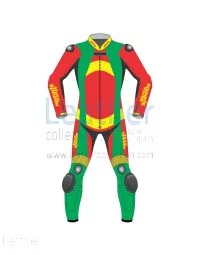
are listed with their own details. The product page for that suit lists CE Level 2 armour under EN 1621-1 but states no EN 17092 class, so the suit should not be read as belonging to class AAA or any other class. Replica-style suits inspired by MotoGP riders are listed among the MotoGP rider suits
, and a one-piece leather set such as the Bravo leather biker suit
is one example. Check the stated class before buying.
Gear Comparison: Leather vs Textile
The label, not the material, confirms the class. Leather is usually heavier and stiffer until broken in; textile is usually lighter and more flexible.
Material
Weight
Flexibility
Leather
Usually heavier
Stiffer until broken in
Textile
Usually lighter
Generally higher
Whatever the material, the class on the label shows which tests the garment met.
Real-World Scenarios: When CE Ratings Matter
A garment tested to a lower class and one tested to a higher class are different tools.
The classes set minimum laboratory results; they do not promise any outcome in a crash. That is why correct fit, correctly positioned protectors and sensible speed matter as much as the label.
Maintaining Your CE Protection
Check the maker’s care label and the armour maker’s service guidance for protective gear.
Tips to Extend Gear Life
Follow the care label or the maker’s instructions; the right cleaning method depends on the material and finish.
Store the garment as the maker advises.
Inspect armour and seams after every fall and replace anything deformed. Some foams work by permanent deformation and are single-use, so check the armour maker’s guidance.
Conclusion: CE Ratings Are More Than Labels
Once EN 17092 and its classes are clear, gear choices become simpler. Class A, AA and AAA describe tested minimums, not a ranking of style.
Check the label for the class and the standard used, then match it to how and where the gear will be worn, from light city wear to a racing suit.
Frequently Asked Questions
What does CE certification mean on motorcycle gear?
It shows the garment was assessed against European requirements for personal protective equipment. For motorcycle clothing, the label also names the protection class and the standard used, such as EN 17092, and carries a motorcyclist pictogram.
What is the difference between EN 17092 and EN 13595?
EN 13595 was the earlier standard for professional riders’ clothing. EN 17092 is the current standard and ran alongside it until EN 13595’s planned withdrawal (March 2023 at the latest, per SATRA). It is a six-part series: one part for test methods and five parts for classes AAA, AA, A, B and C. The classes make it easier to compare garments by intended use.
Is CE certification mandatory?
In the EU, motorcycle clothing counts as personal protective equipment under Regulation (EU) 2016/425, so it must be CE marked before sale. Rules in other regions differ, and riders there can still use the EN 17092 class on the label as a comparison tool.
Can textile gear reach AAA?
The class depends on the tests a garment meets, not on the material. Class AAA sets the highest abrasion, tear and seam requirements, and the label, not the material, is what confirms the class. Check the label rather than assuming a class from the fabric.
Does CE armour need replacing?
Replace armour after a significant impact or when it is deformed or damaged. Some foams absorb energy by permanent deformation and are single-use. Check the protector maker’s instructions for guidance on how long a specific product stays in service.

 USA
USA  Brazil
  Germany
  France
  Italy
Italy  Switzerland
  Sweden
  Spain
Spain  Great Britain
  Norway
  Russia
  South Africa
  Japan
Japan  New Zealand
  Australia