 USA
USA  Brazil
  Germany
  France
  Italy
Italy  Switzerland
  Sweden
  Spain
Spain  Great Britain
  Norway
  Russia
  South Africa
  Japan
Japan  New Zealand
  Australia
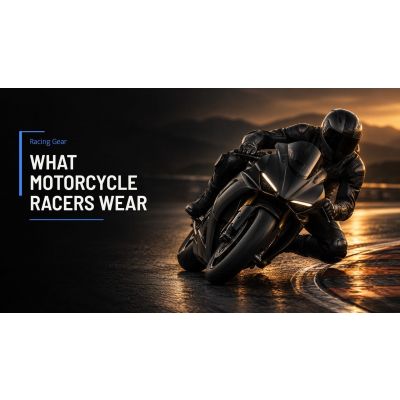
Watch a MotoGP race and riders lean into corners at angles of up to 65 degrees from vertical, at speeds of over 350 km/h, wearing leather suits that follow the body like a second skin (MotoGP.com). What is that rider gear made of? Why does it look so different from a regular leather jacket? And can a rider wear something similar on the road or at a track day?
Understanding what MotoGP riders wear and why helps when choosing leather apparel for yourself. Whether you are a motorcycle enthusiast, a casual rider, or someone who likes the look of racing leather, this guide explains the reasons behind each design choice: protection, performance, and years of engineering. Knowing what professionals choose makes it easier to match gear to a real riding style.
Key Takeaways
- MotoGP suits are made to each rider's measurements, while suits for buyers come in standard sizes or can be made to measure; both are built around abrasion-resistant leather, usually cowhide or kangaroo, with armour protectors at the joints.
- Features such as knee sliders, the back hump and an integrated airbag each have a specific job on the track; most do not matter for commuting.
- EN 17092 is the current standard for motorcycle protective garments, including one- and two-piece suits, and its classes show what protection a garment is tested for.
- Fit decides how well armour and reinforcement work: a suit should feel snug in the riding position, not only when standing.
- Replica suits are inspired by MotoGP designs; match the construction to how and where you actually ride.
Table of Contents
- What Is MotoGP Racing Leather?
- The Layers: How MotoGP Suits Protect Riders
- Materials Used in Professional Racing Gear
- Fit and Design: Why MotoGP Suits Look Different
- Modern Technology in Racing Leather
- Street Gear vs. Track Gear: Key Differences
- Choosing the Right Leather for Your Riding Style
- Custom Sizing and Made-to-Measure Options
- Common Mistakes When Buying Racing Leather
- Care and Maintenance of Racing Leather
- Buyer's Checklist
- Frequently Asked Questions
What Is MotoGP Racing Leather?
MotoGP leather isn't just a thicker version of a regular motorcycle jacket. It is a complete protective system for professional racers traveling at extreme speeds, while keeping the agility and freedom of movement needed for competitive riding. According to MotoGP.com, suits are made to fit each rider precisely. A MotoGP one-piece or two-piece leather suit has reinforced panels in high-impact zones and ventilation to manage heat during intense performance.
Professional racing leather combines multiple materials: abrasion-resistant hides, mesh panels and armour inserts, all working together. The construction is typically heavier than street leather, with seams reinforced for crash protection rather than everyday comfort.
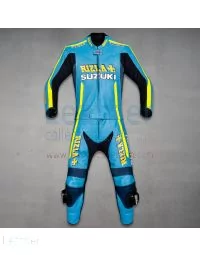
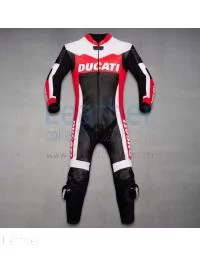
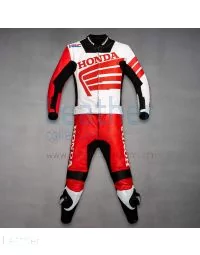
Replica suits follow the designs seen on the grid, and are inspired by the colours and graphics of teams and riders rather than being the suits the riders race in. They are made in standard sizing or to the buyer's measurements, and copy the look of the racing suit; check each listing for materials, armour and any EN 17092 class.
The Layers: How MotoGP Suits Protect Riders
A professional MotoGP leather suit typically has multiple protective layers, each serving a specific purpose:
Outer Leather Shell
The outermost layer is leather. MotoGP.com names kangaroo and cowhide as the usual choices. This layer resists abrasion during a crash and gives the suit its structure. A fashion jacket is not a substitute for a garment made for the track.
Impact-Resistant Panels
Reinforced panels are placed on the shoulders, elbows, hips, and knees, the areas most likely to contact the track during a slide. These panels may be made from thicker leather or abrasion-resistant textiles designed to slow down wear.
Armour and Protective Inserts
Riders wear armour protectors in strategic locations. These are rigid or semi-rigid inserts that protect bones and joints: shoulder, elbow, knee and hip protectors are either built into the suit or fitted into pockets for removable pieces. In the European standard, impact protectors for these areas are covered by EN 1621, and they are required in the top two garment classes of EN 17092 (SATRA).
Lining and Interior Comfort Layer
The interior of a MotoGP suit typically features a moisture-wicking lining to manage sweat during high-intensity riding. Many professional suits use breathable mesh or perforated leather panels in the underarms, back, and inner thighs to allow airflow while maintaining protection.
Materials Used in Professional Racing Gear
Cowhide: A Staple of Racing
Cowhide is one of the two leathers MotoGP.com names for racing suit outer layers. It is naturally tough, resists abrasion, and breaks in over time while keeping its protective qualities.
Lambskin: For Comfort Zones
Some racing suits blend cowhide with lambskin in areas where comfort is prioritized, such as the chest area or inner thighs. Lambskin is softer and more pliable, which allows better movement, but it is thinner and gives less abrasion resistance than a heavier hide, so it belongs in low-risk zones.
Kangaroo and Other Leathers
Kangaroo leather is the other material named for outer layers of MotoGP suits alongside cowhide. Suit makers choose it where weight and flexibility matter. Some manufacturers also use other hides, so the labeled leather type is worth checking on any suit.
Synthetic and Mesh Components
Modern racing suits often combine leather with mesh panels made from nylon, polyester, or Cordura. These materials provide ventilation and reduce weight in less critical impact zones, while leather stays where abrasion is most likely.
Fit and Design: Why MotoGP Suits Look Different
If you've noticed that MotoGP suits look different from street motorcycle jackets, you're observing real functional differences:
Aggressive Forward Lean Design
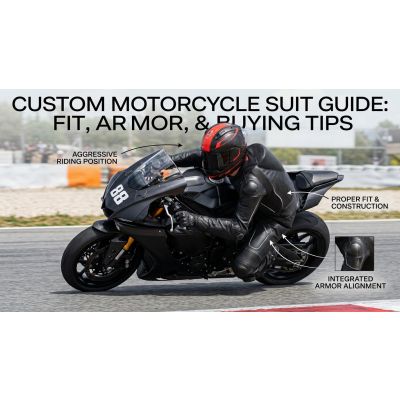
MotoGP suits are cut with a forward-lean design. When you put on a racing suit and assume a riding position, it should fit snugly against your body with no bunching or excess material. This design accounts for the rider's body position when leaned into a corner at angles of up to 65 degrees. The shoulders sit higher, the arms reach forward, and the waist is tighter than on street gear.
Strategic Seam Placement
Seams on a racing suit are positioned with the abrasion zones in mind. Where possible they run to the sides or through low-stress areas, away from the point of the shoulder or the front of the elbow, which are the places most likely to slide along the track.
Knee Sliders
MotoGP suits carry replaceable sliders on the knees, and also on the elbows and shoulders, sitting on the outside of the leathers so that riders can brush the track surface in a corner (MotoGP.com). Street motorcyclists do not use knee sliders because they do not lean their bikes nearly as far over.
The Back Hump
Many racing suits have a built-up hump on the upper back. According to MotoGP.com, the speed hump was originally invented to reduce aerodynamic drag, and it now also houses items such as data logging devices, water bladders and the electronics for airbags. Street gear has no such feature because riders sit more upright.
Suit Connectivity
A one-piece suit has no waist seam that can separate in a slide. Two-piece racing suits join the jacket and pants with a connecting zip around the waist, which keeps the two halves together. This connection matters for racing but is less necessary for street riding.
Modern Technology in Racing Leather
Airbag Integration
MotoGP suits now carry wearable airbag technology. Using accelerometers, gyroscopes and GPS, these systems detect a fall and are designed to inflate within 0.045 seconds of the start of a crash, and aim to protect the chest, shoulders, ribcage, upper back and neck, according to MotoGP.com. This adds a layer of protection beyond the leather and armour.
Safety Standards and EN 17092
EN 17092 is the current European standard for protective garments for motorcycle riders, including jackets, pants, and one- and two-piece suits. It sets the test methods, and its classes range from AAA and AA to A, B and C: AAA and AA require elbow, shoulder, knee and hip impact protectors, while Class B covers abrasion protection without protectors (SATRA). When a maker states a class, it describes what the garment was tested for; it says nothing about the outcome of an individual crash.
Ventilation Systems
Modern racing suits include perforated leather sections, mesh gussets, and ventilation panels to allow airflow without leaving the main impact zones unprotected. Perforation is usually kept away from the areas most exposed to a slide.
Ergonomic Design Improvements
Racing suit patterns are cut for the riding position: pre-shaped arms and legs, and stretch panels at the elbows, knees and back, keep the suit from restricting movement when the rider is tucked on the bike.
Street Gear vs. Track Gear: Key Differences
| Feature | MotoGP Track Suit | Street Motorcycle Gear |
|---|---|---|
| Fit | Aggressive forward-lean, snug fit, racing posture | Upright or moderate lean, comfortable for everyday riding |
| Leather Thickness | Heavier, abrasion-resistant leather with reinforced panels | Lighter leather, balanced protection and comfort |
| Armour Location | Multiple impact zones, specialized placement | Shoulders, elbows, back—standard placement |
| Knee Sliders | Yes, replaceable pads | Rarely, not needed for street riding |
| Ventilation | Optimized for high-speed airflow | Balanced protection and breathing |
| Jacket-Pants Connection | Connected one-piece or zip-together two-piece | Often separate, some two-piece options |
| Everyday Wearability | Specialized for track use | More versatile, suitable for commuting |
Choosing the Right Leather for Your Riding Style
If You're a Professional or Track Day Rider
Look for racing leather from an established maker, with armour integration and reinforced seams, and ask which EN 17092 class the garment is tested to. A suit made to the rider's measurements fits closely in the riding position, which matters for how armour sits at the joints. A track-focused suit should have knee sliders, a back hump, and one-piece or zip-together two-piece construction. Race-grade options are collected in , with more track-oriented pieces such as the listed in the range.
If You're a Regular Commuter or Casual Rider
A full racing suit is not needed. Look instead for a well-made leather motorcycle jacket or a two-piece leather set designed for street riding. Street gear should be comfortable for everyday wear while still offering solid protection. Focus on fit, lining and sensible armour placement: the leather has to work for an upright riding position, not an aggressive racing posture.
If You Ride Hard but on the Street
Riders who ride hard on the street are in a middle ground. Consider a well-made leather motorcycle jacket with reinforced panels and good armour placement. Some manufacturers make sport-touring leather that borrows design cues from racing gear, such as thicker leather and strategic reinforcement, while keeping a more wearable fit for the street.
If You're a Collector or Enthusiast
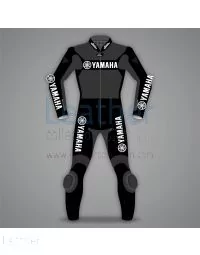
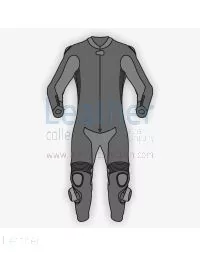
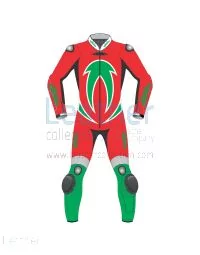
MotoGP replica suits suit collectors and fans. They are inspired by the designs and colours of professional teams and riders and come in standard sizing, copying the look of racing suits; check each listing for materials, armour and any EN 17092 class. is one example of a racing-style suit, and the is inspired by the look of a Yamaha factory team.
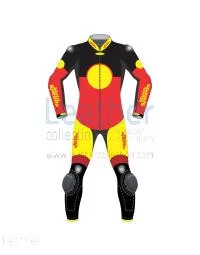
For more team and rider styles, see in the replica range, or for suits modeled on specific riders.
Custom Sizing and Made-to-Measure Options
One of the main advantages of racing-style leather is the option for custom sizing. Unlike off-the-rack street jackets, racing suits can be made-to-measure from your own body measurements.
When Custom Sizing Is Worth It
If you are very tall or short, have an athletic build, or fall between sizes on standard charts, custom sizing is worth considering. A properly fitted racing suit feels more comfortable than a generic size that is slightly off. Professional racers wear custom suits because a poor fit compromises both protection and performance.
What Gets Measured
Custom suits typically require measurements of your neck, chest, waist, hips, sleeve length, torso length, and inseam. Some manufacturers also take postural measurements—they'll measure you in your actual riding position to ensure the suit fits correctly when you're leaned forward on the bike.
Taking Your Measurements
A made-to-measure suit is only as good as the measurements it is cut from. Measure over thin clothing with a flexible tape, ideally with a helper, and compare each figure against the maker's measuring guide. Re-check anything that looks out of proportion before ordering. A suit that fits properly tends to sit without bunching in the riding position, which reduces stress on seams.
Common Mistakes When Buying Racing Leather
Mistake #1: Choosing Fit Based on Fashion, Not Function
Buying a racing suit one size too large "for comfort" defeats the purpose. Racing leather should fit snugly. If it feels tight standing upright, try it in a riding position: what feels tight standing up often feels right when leaned forward on the bike. Oversized suits let armour drift away from the joints it is meant to cover.
Mistake #2: Ignoring Leather Quality Differences
Not all leather is the same. Racing suits use hides chosen and tanned for abrasion resistance, while cheaper garments may use thinner or lower-grade leather. Ask the maker which hide is used, how thick it is, and which standard the garment is tested to.
Mistake #3: Buying Based on Price Alone
Very cheap suits that look like racing gear may use thin leather or synthetic panels. Compare stated materials, armour type and standard conformity rather than styling alone. Price tells less than the specification does.
Mistake #4: Forgetting About Armour Compatibility
Some racing suits come with armour; others are designed to accept removable armour pieces. Before buying, confirm whether the suit includes armour and whether you can upgrade or customize armour inserts later. This flexibility matters if you want to adjust protection levels for different riding conditions.
Mistake #5: Not Considering Your Actual Riding Style
Buyers sometimes purchase racing suits when they only commute, and end up with gear that is uncomfortable for its real use. Be honest about whether racing-level construction is needed or whether a well-made street motorcycle jacket would serve better.
Mistake #6: Skipping Seam and Stitch Inspection
Examine seams closely. Racing leather should have reinforced stitching, sometimes double-stitched or triple-stitched in critical areas. Loose threads, uneven stitching or gaps are warning signs of poor construction. Run a finger along the seams and look for even, tight stitching.
Care and Maintenance of Racing Leather
Care for racing leather depends on the leather and the maker's instructions.
After Every Ride
Wipe down your suit with a soft, dry cloth to remove dust and moisture. Don't hang racing leather in direct sunlight, which can fade colour and dry out the hide. Store it in a cool, dry place away from heat sources.
Conditioning
Follow the maker's care label; the right product depends on the leather finish and construction. Use only products suited to the leather, and test on a hidden area first.
Armour Care
Check armour inserts regularly to ensure they're still properly positioned and haven't compressed unevenly. Follow the armour maker's cleaning instructions, since the right method depends on the protector and the suit.
After a Crash or Slide
Inspect the suit carefully for damage. Surface scuffs may be cosmetic, but deep gouges in the leather or compromised seams mean the suit should be professionally repaired or, in severe cases, replaced. Don't ride in damaged protective gear, as its protective integrity is compromised.
Professional Cleaning and Repair
Periodically, consider professional cleaning from a specialist who understands motorcycle leather. They can deep-clean the lining, condition the leather properly, and address any seam separation before it becomes a major issue.
Buyer's Checklist: Before You Buy Racing Leather
Use this checklist to evaluate racing leather before making your purchase:
- Leather Quality: Does the maker state the hide type and thickness?
- Seam Construction: Are seams reinforced, double-stitched, or triple-stitched? Are stitches tight and even?
- Fit for Your Riding Position: Does it fit snugly in your normal riding posture? (Not when standing upright)
- Armour and Protection: Is armour included? Is it tested to EN 1621? Can it be upgraded or replaced?
- Strategic Reinforcement: Are there reinforced panels on shoulders, elbows, hips, and knees?
- Knee Sliders (if racing): Are they included and replaceable?
- Connectivity Options: If you want separate jacket and pants, do they zip together?
- Ventilation: Are there mesh panels or perforations in high-heat areas?
- Safety Standard: Does the maker state an EN 17092 class for the garment?
- Lining Quality: Is the interior breathable and moisture-wicking?
- Brand Reputation: Is it from an established motorcycle gear manufacturer with a track record among riders?
- Sizing Information: Does the maker publish clear measuring guidance and a size chart?
- Care Instructions: Are maintenance and cleaning instructions clear and included?
- Specification Against Price: Do the leather, armour and construction justify the price compared with similar suits?
- Actual Use Case: Does this suit match your real riding style and needs?
Conclusion: Making Your MotoGP Leather Choice
Understanding what MotoGP riders wear and why gives you the knowledge to make better decisions when choosing leather apparel. Professional racing gear is engineered protection, not just expensive fashion, and every detail on a MotoGP suit serves a purpose: leather type, seam placement, armour integration and fit.
Whether you are buying track-focused gear, a MotoGP replica suit, or well-made street motorcycle leather, the principles are the same: look for genuine leather, fit the body correctly, choose reinforcement in the right places, and match the gear to your actual riding style. Racing-grade leather is designed for the track, and a street rider does not necessarily need a full .
Take time to measure yourself correctly, understand the differences between track and street gear, and inspect construction carefully. Careful choice and regular care keep a leather suit in good condition for years.
Frequently Asked Questions
Can I wear a MotoGP racing suit for street riding?
Technically yes, but it is not ideal. MotoGP-style suits are designed for aggressive riding positions on controlled tracks. The fit is aggressive, with raised shoulders and forward-lean tailoring that feels uncomfortable when sitting upright in traffic. Street motorcycle jackets are more wearable for commuting while still offering solid protection. If you do track days regularly, a racing suit makes sense as primary gear, and many riders own both.
What is the difference between a one-piece and a two-piece racing suit?
A one-piece suit is a single connected garment, so it has no waist seam that can separate or ride up in a slide. That is why racers favor it. A two-piece racing suit has a separate jacket and pants that zip together at the waist, which makes it easier to put on, take off and wear off the bike. The difference is mainly convenience against the security of one continuous garment.
Is cowhide better than lambskin for racing?
For abrasion resistance, cowhide is the stronger choice. It is thicker and tougher, which matters in a slide. Lambskin is softer and more comfortable but thinner. MotoGP.com names kangaroo and cowhide as the usual outer leathers on racing suits. Many suits combine heavier hide in impact areas such as shoulders, elbows, hips and knees with softer leather or panels in comfort areas.
Do I need custom-sized racing leather?
If a stock size fits reasonably well, it can work. Custom sizing gives a closer fit if you are significantly larger or smaller than standard charts, or have an athletic build between sizes. Professional racers wear custom suits because poor fit compromises both protection, since armour no longer lines up with the joints, and performance, since uncomfortable seams affect concentration.
Which standard applies to motorcycle racing suits?
EN 17092 is the current European standard for motorcycle protective garments, including one- and two-piece suits. Its classes are AAA, AA, A, B and C. Classes AAA and AA require impact protectors at the elbows, shoulders, knees and hips, and these protectors are covered by EN 1621. A stated class describes what the garment was tested for, not a result in a crash.
Written by the Leather Collection Editorial Team.