 USA
 Brazil
 Germany
 France
 Italy
 Switzerland
 Sweden
 Spain
 Great Britain
 Norway
 Russia
 South Africa
 Japan
 New Zealand
 Australia

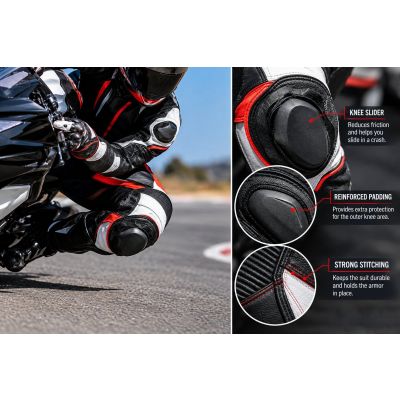
Knee sliders are the small, replaceable pads on the outer knees of a racing suit. They are often described as crash protection, but their main jobs are different: they let a rider feel lean angle and they protect the suit when the knee touches the ground in a corner. Knowing what they do, and what they do not do, makes it easier to judge a racing suit.
Key Takeaways
- Knee sliders give feedback on lean angle: the knee acts as a sensor for how far the rider is leaned over.
- They are made from tough, smooth materials such as plastic, polyurethane or nylon composites, and they wear down and get replaced.
- Sliders are not impact armour; impact protection for the knee comes from armour tested under EN 1621-1.
- Placement and suit fit decide whether the slider touches the ground where it should.
What Knee Sliders Do
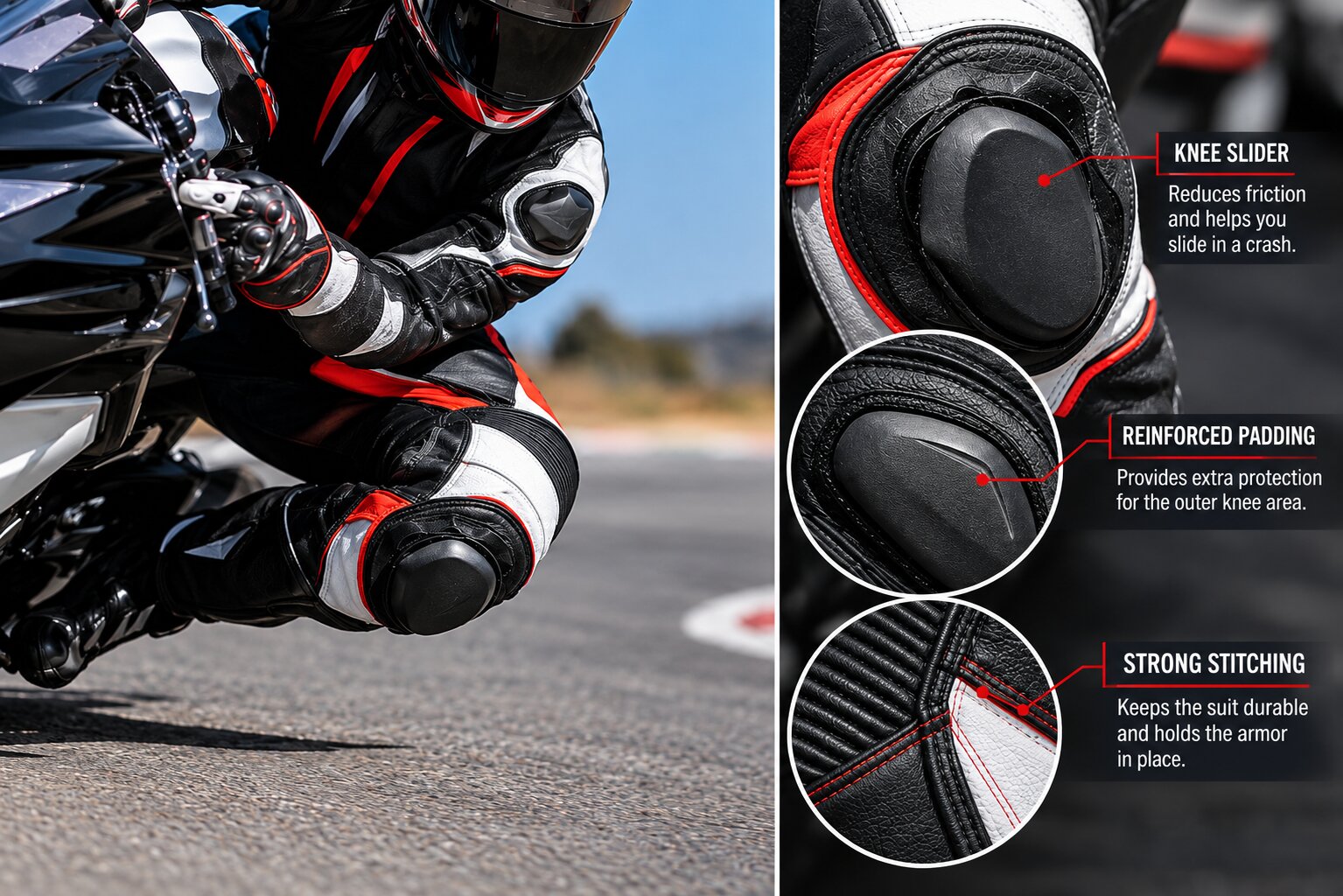
According to MotoGP.com, dragging a knee acts as a kind of sensor, so riders can gauge what angle of lean they are at. Sliders are the replaceable pads that make this possible. They are fixed to the outer knee area of a racing suit, so the pad meets the surface instead of the leather of the suit itself, and the rider can lean further with a clear signal of how close the limit is.
Plastic and polyurethane are common slider materials because they are tough, smooth and inexpensive, and nylon composites offer even less friction for better glide. Wear varies with the rider and the corner. As noted by former racer Simon Crafar on the same page, some riders fit new sliders every session while others get several days of use from a set. Because they are consumables, replaceable sliders are a practical feature on any suit used for track work.
Where the Technique Comes From
The technique is usually traced to the early 1970s, when Kenny Roberts Sr. pioneered knee dragging, inspired by Jarno Saarinen. Riders such as Mick Doohan, Valentino Rossi and Marc Marquez later became closely associated with it as it evolved. MotoGP.com also notes that riders drag a knee mainly in fast, high-lean corners, and avoid it in tight low-speed turns, in wet conditions and on straights where heavy lean is not needed.
What Knee Sliders Do Not Do
Sliders are not impact armour. Impact protection for the knee comes from limb protectors certified under EN 1621-1, the part of the standard that covers limb joint impact protectors. Abrasion resistance in a crash comes from the suit material and seams, not from a small pad on the outside of the knee.
That distinction matters when comparing suits. A suit with large sliders but thin armour or weak seams is not better protected than one with modest sliders and strong construction. Sliders add feedback and a sacrificial surface; they do not replace the armour and the leather.
Slider Placement and Fit
Sliders belong on the outer knee, in the spot where the knee meets the ground at full lean. Placement depends on the suit being cut and worn correctly: if the suit is loose, the slider can sit off the knee in the riding position. Fit in the riding position is the first check, which is one reason riders compare with measurements in hand.
MotoGP.com notes that Marc Marquez popularised getting the elbow down as bikes advanced, and some riders now add elbow sliders for the same reason. Extras make sense only when the base suit has good armour, a sound fit and strong seams.
What to Check on a Racing Suit
- Attachment: sliders should be fixed securely and, if they are meant to be replaced, easy to swap.
- Material: a smooth, hard-wearing surface such as polyurethane or a nylon composite.
- Position: centered on the outer knee when the rider is in the riding position.
- Armour underneath: knee protectors with an EN 1621-1 marking and a stated level.
- Suit construction: abrasion-resistant leather, strong seams and a suit that fits snugly without restricting movement.
Leather Collection builds made-to-order, hand-stitched suits, and has done so since 2009. Riders can compare and the wider
range side by side, and view the specification of each suit before choosing.For a single product to check against the points above, the
can be reviewed on its product page.Frequently Asked Questions
Do knee sliders protect the knee in a crash?
Not directly. Sliders mainly provide feedback on lean angle and a sacrificial surface when the knee touches down in a corner. Impact protection comes from knee armour certified under EN 1621-1, and abrasion resistance comes from the suit leather and seams. A suit needs all three to be considered protective.
How often do knee sliders need replacing?
It depends on the rider and the track. Former racer Simon Crafar notes on MotoGP.com that some riders fit new sliders every session while others get several days of use. Sliders are consumable parts, so checking that they can be replaced is a practical point when choosing a suit.
What materials are knee sliders made from?
Plastic and polyurethane are common because they are tough, smooth and inexpensive, and nylon composites offer even less friction so the slider glides across the surface. The aim is a hard-wearing, low-friction surface that can be replaced as it wears, rather than a pad that grips the ground.
Do road riders need knee sliders?
Sliders are most useful where a rider leans far enough for the knee to touch the surface, which is typically on track. Riders who do not corner at those angles will rarely use them. Armour, abrasion-resistant material and good fit matter on every ride, whether or not sliders are fitted.
Can sliders be added to an existing suit?
Some suits are made with slider mounting points, and others are not. Whether sliders can be added depends on the suit design, so the maker or a leather repair specialist should be asked before buying parts. Modifying a suit can also affect how it fits and wears, so it is worth asking about before any alteration.
Written by the Leather Collection Editorial Team.