 USA
 Brazil
 Germany
 France
 Italy
 Switzerland
 Sweden
 Spain
 Great Britain
 Norway
 Russia
 South Africa
 Japan
 New Zealand
 Australia

Motorcycle gear listings are full of letters, levels and numbers, and they are easy to misread. A rider who sees an AA label may assume it describes the armour, when it classifies the garment. Another may focus on leather thickness and miss armour placement or fit. Reading the specification correctly starts with knowing which standard describes which part of the product.
Key Takeaways
- EN 17092 classifies the whole garment (AAA, AA, A, B or C); EN 1621 rates the impact protectors inside it.
- Classes AAA, AA and A of EN 17092 include impact protectors; class B has abrasion protection without impact protectors; class C is a protector-carrying layer with no minimum abrasion protection.
- EN 1621 Level 2 transmits less force than Level 1 in the standard test, for limb protectors and for back protectors alike.
- Armour only works where it sits: coverage, placement and fit belong on the same checklist as the ratings.
Quick Answer
Two separate standards matter on most product pages. EN 17092 is the garment standard, with five classes. EN 1621 covers the impact protectors, with Level 1 and Level 2. A product that lists only one of them describes only half of its protection, so both should be checked along with where the armour sits and how the item fits.
What Do the Letters AAA, AA, A, B and C Mean?
The letters come from EN 17092, the European standard for motorcycle protective garments. The classes are ordered by test severity. Class AAA provides the highest level of protection from impacts and abrasion, with potential ergonomic penalties, class AA offers protection for a wider range of riding with lower penalties, and class A has the least ergonomic and weight penalties of the three. Class B covers specialized garments with the abrasion protection of class A but without impact protectors, and class C garments are designed to provide impact protection for the areas covered by the impact protectors only, with no minimum abrasion protection, according to SATRA.
The abrasion test uses the Darmstadt machine, in which material samples are mounted on rotating arms and brought down onto a concrete tile to simulate a rider sliding to a stop. A product passes only if no hole of 5 mm or more opens in the body-facing layer. The standard also contains requirements for tear and seam strength, so the class reflects the garment as a whole rather than the leather alone.
A common mistake is to read AA or AAA as a statement about armour quality. The class sets what the garment must withstand and which impact protectors it must include, but the rating of those protectors comes from EN 1621. A garment can carry a high class and still have limited armour coverage, so both pieces of information are needed.
How Impact Armour Ratings Work (EN 1621)
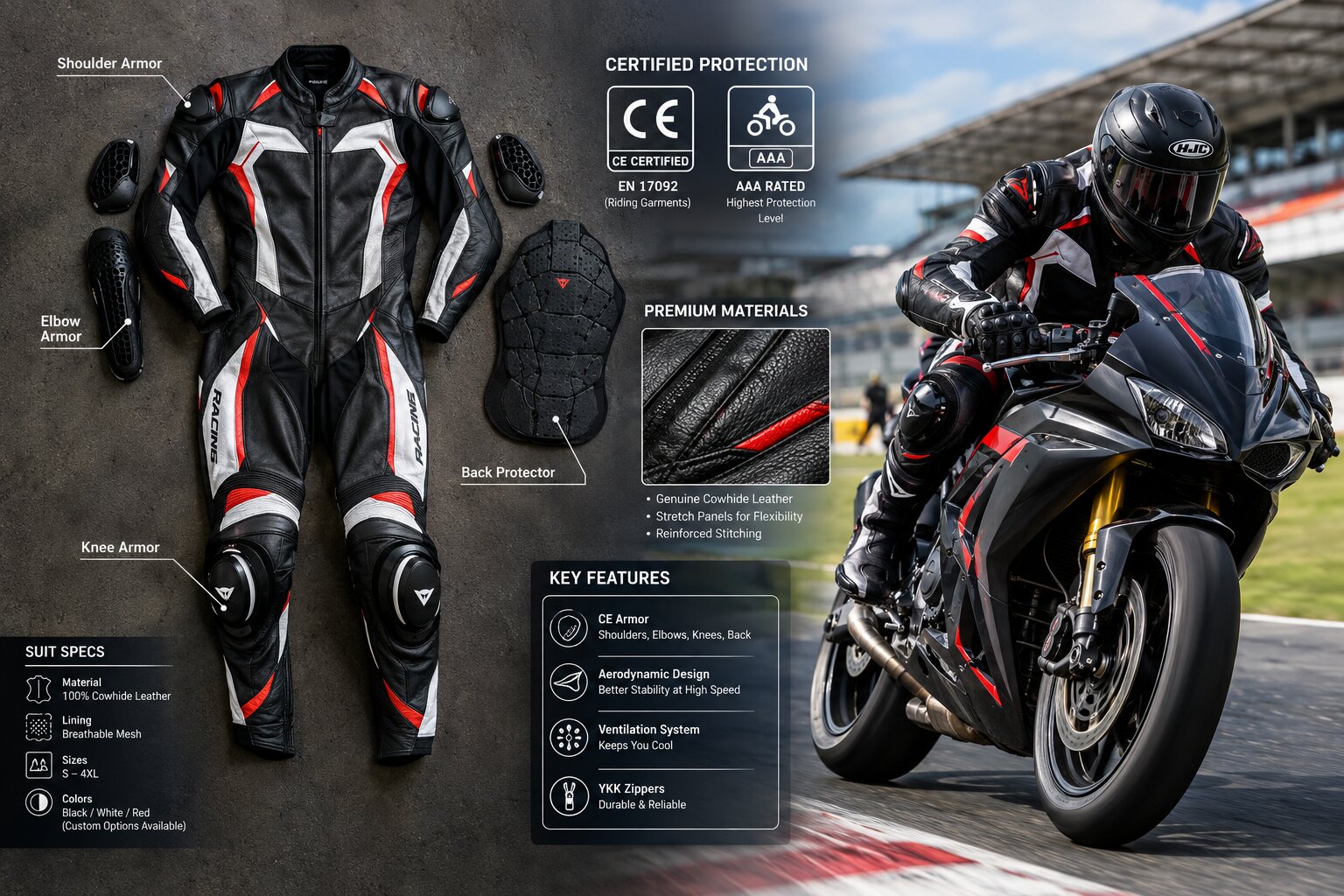
Impact protectors are tested separately under EN 1621. Part 1 covers limb joint protectors such as shoulder, elbow, hip and knee armour, part 2 covers back protectors, part 3 covers chest protectors, and part 4 covers inflatable protectors. In each case a mass is dropped onto the protector and the force transmitted through it is measured; the less force that gets through, the better the protector scores.
For limb protectors under EN 1621-1, Level 1 requires a mean transmitted force below 35 kN with no single value over 50 kN, and Level 2 requires a mean below 20 kN. For back protectors under EN 1621-2, SATRA gives a mean below 18 kN with no single value over 24 kN for Level 1, and Level 2 sets lower limits. Level 2 therefore transmits less force than Level 1 in the standard test, but the level says nothing about whether the armour covers the right area.
On a product page the marking should name the part and the level, for example EN 1621-1 Level 2 for limb protectors or EN 1621-2 Level 2 for a back protector. If the listing only says protectors are fitted, the seller or maker should be asked which part and level they meet.
Leather Type and Thickness
Thickness is often quoted in millimeters, but it is one factor among tanning, finish and construction, and a single figure cannot describe the whole garment. Tanning, finish, panel layout and seam construction all affect how a suit behaves in a slide, which is why the EN 17092 class, tested on the garment materials and seams, is more informative than thickness alone. Product pages rarely describe tanning method or grade, so those questions can be put to the maker directly.
Reinforced panels are worth looking for. Double-layer leather or extra stitching at the shoulders, elbows and hips is a construction detail to ask the maker about, and the EN 17092 class remains the tested reference. Riders comparing suits can browse the and sections side by side.
Why Armour Placement Matters as Much as the Rating
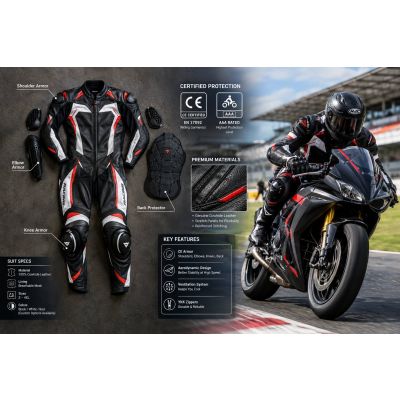
Armour with a good level protects only the area it covers. Listings should state which zones have protectors: shoulders, elbows, hips, knees and back are the usual ones, and some suits add chest protection. A diagram or a list such as removable Level 2 armour at the shoulders, elbows, hips and knees is a better sign than a general mention of protective padding.
Riding position changes what matters. A sportbike rider leans forward and loads the shoulders and elbows, while a rider on an upright bike may care more about hip and tailbone coverage. Riders looking for everyday road gear can look at the
section.How Fit Affects Real Protection
A well-rated suit that fits poorly protects less than a well-fitted suit, because armour that moves off the joint cannot do its job. A jacket that is too loose bunches or shifts. One that is too tight tires the rider and limits control on long rides. A size chart with chest, waist, sleeve length and inseam should be compared to the rider's own measurements rather than to street clothing sizes.
Custom sizing is useful for riders outside the standard ranges and allows armour to be positioned to the individual body. It does not change the class or level of the materials. Testing the fit in the riding position is the most reliable check: reach for the handlebars, and confirm nothing pulls on the back or sleeves and that the armour stays over the joints.
Common Mistakes When Reading Specs
- Reading the class as the armour rating. EN 17092 classifies the garment; EN 1621 rates the protectors.
- Ignoring placement. A suit with armour only at the elbows and knees covers less than one that also has shoulder, hip and back protectors, whatever the level.
- Relying on thickness alone. Construction, seams and finish also decide how leather performs.
- Overlooking seams. The standard includes tear and seam strength requirements for the garment.
- Assuming one mark covers everything. A listing should state both the garment class and the armour level.
- Skipping the fit check. Specifications are written for a body that fits the garment.
What to Check Before Buying
- The EN 17092 class (AAA, AA, A, B or C) and whether it includes impact protectors.
- The EN 1621 part and level of each protector, and which body areas they cover.
- Leather type and construction details such as reinforced panels and seam stitching.
- Size chart measurements compared to the rider's own.
- Whether armour is included or sold separately, and whether it can be removed for cleaning.
- Care instructions for the leather.
For a single product to read against this list, the
shows how armour placement, construction and fit details can be reviewed on a product page.Frequently Asked Questions
What does an AA rating mean on motorcycle gear?
AA is a class of EN 17092, the garment standard. It sits between AAA and A, offers protection for a wide range of riding with lower ergonomic penalties than AAA, and includes impact protection requirements. It does not state the level of the armour, which is rated separately under EN 1621.
Is Level 2 armour always better than Level 1?
In the standard test Level 2 transmits less force than Level 1: for limb protectors under EN 1621-1 the mean must be below 20 kN at Level 2 against below 35 kN at Level 1, and back protectors have lower limits at Level 2 as well. A higher level helps only if the armour covers the area that is hit, so coverage, placement and fit belong in the comparison.
What if a listing does not name the armour level?
The seller or maker should be asked which EN 1621 part and level the protectors meet, and which body areas they cover. A listing that only mentions protective padding does not give enough information to compare products, and a clear answer is a reasonable condition for a purchase.
Does custom sizing change the safety classification?
No. Custom sizing does not change the class or level of the materials. It lets the garment and armour positions be matched to the rider's body, which supports armour staying over the joints. Measurements should be accurate for that to work, and the product class and armour level should still be checked.
Written by the Leather Collection Editorial Team.