
 USA
 Brazil
 Germany
 France
 Italy
 Switzerland
 Sweden
 Spain
 Great Britain
 Norway
 Russia
 South Africa
 Japan
 New Zealand
 Australia

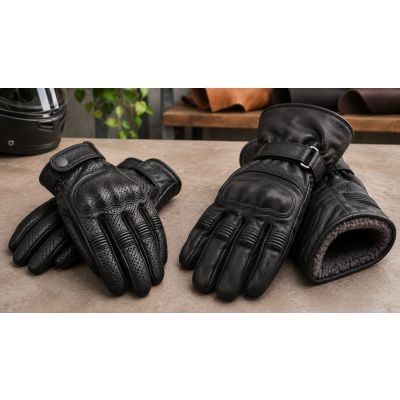
Short answer: summer gloves add airflow, with perforated leather, thinner lining and a short or mid-length cuff. Winter gloves add warmth, with insulation, a longer cuff and sometimes a membrane. Neither type changes the protection that matters: palm sliders, knuckle protection and a certified construction. Choose by the temperatures you ride in and how long you ride, not by a "best of" list.
Summer gloves: what to look for
- Perforation. Small holes in the leather let air through to your hand. They cool you most at speed and do much less when you are stopped in traffic. Our article on perforated motorcycle leather explains how perforation works and what it does to abrasion resistance.
- Short or mid cuff. A short cuff keeps the wrist cool and is easy to put on, but it leaves a gap between glove and jacket sleeve unless your sleeve covers it.
- Thin lining. A thin or no lining reduces heat and bulk and improves feel on the controls.
- Vent patches. Mesh or vent panels on the fingers or back of the hand add airflow without weakening the palm.
A summer glove is usually thinner and more flexible. That improves feel, but a very thin glove has less cushion if you fall.
Winter gloves: what to look for
- Insulation. A thermal lining traps warm air. Thicker is warmer but reduces finger movement, so check you can still work the levers.
- Long cuff. A gauntlet cuff covers your wrist and fits over or under your jacket sleeve to block cold air.
- Membrane. A membrane liner helps block wind and water. It can reduce breathability, which matters on long rides.
- Wrist closure. A strap or cinch keeps the cuff sealed against your sleeve.
Cold hands are a riding problem as well as a comfort problem, because numb fingers react slowly. Official rider-training and safety bodies publish cold-weather riding advice; check theirs for current guidance.
Leather type and thickness by season
Thicker leather protects more but feels stiffer and warmer. Thinner leather is cooler and gives better feel on the controls. A glove built for the track may use a thicker palm and perforation only in low-wear areas. A winter glove usually has thicker outer leather plus lining.
If you want to compare features like short versus gauntlet cuffs, palm padding and knuckle protection, our gloves buying guide goes through each.
Protection stays constant
Whatever the season, the protective features should not change. Look for:
- Knuckle protection that is part of the glove, not just sewn on for looks.
- A reinforced palm, with sliders in the right places if the glove has them.
- Strong stitching and a secure wrist closure.
- A certified construction. EN 13594 is the European standard for motorcycle riders' gloves; our explainer on EN 13594 gloves and EN 13634 boots shows what it tests. Read the summary of the standard, and ask the maker whether a glove is certified, instead of assuming.
Perforation, thin lining and thick insulation are comfort choices. They should not be reasons to buy a glove with less protection than your riding needs.
Cuff length and jacket pairing
| Cuff | Best for | Pairing with a jacket |
|---|---|---|
| Short | Summer, short rides, commuting | Jacket sleeve should cover the gap |
| Mid | Spring and fall | Can go under or over the sleeve |
| Gauntlet | Winter, touring, track | Usually over the sleeve, with a cinch to seal |
A short cuff under a loose jacket sleeve works in warm weather. If the sleeve rides up when you reach for the grips, you will see skin. Try the combination before you rely on it.
A temperature guide you can test yourself
We do not give fixed temperature ranges, because rider tolerance, speed, wind and the bike all change what feels right. Use this self-test instead:
| Your hands feel | Likely need |
|---|---|
| Hot and damp after 30 minutes | Perforated, thinner glove |
| Fine in the first 20 minutes, cold after an hour | Lined mid glove or gauntlet |
| Numb within 20 minutes | Insulated gauntlet; check heat or layering |
| Cold in wind, fine when still | Longer cuff and a wind-blocking layer |
Note which glove you wore and how long you rode. After a few rides you will have your own numbers.
What Leather Collection gloves offer
Our custom motorcycle gloves and custom leather gloves pages show the styles and options available. See the product page for the current lining, perforation and cuff options. We do not offer a waterproof or rain liner on gloves. For track riding, see our guide on how to choose racing gloves.
One pair or two?
A three-season glove, with a mid cuff, moderate lining and light perforation or none, covers many riders for most of the year. Riders who commute year round, or ride in both heat and cold, usually end up with two pairs: a perforated summer glove and an insulated winter one. Rotating pairs also lets each pair dry between rides.
Common mistakes when choosing seasonal gloves
- Buying on warmth alone. A very thick winter glove can reduce feel on the brake and clutch levers. Check that you can still work the controls precisely, with the glove on.
- Choosing perforation for a long highway ride in the cold. The same airflow that cools you in summer chills you in winter. If you ride in a range of temperatures, a mid-weight glove with a liner you can add or remove can be a better answer.
- Ignoring the wrist. Cold air reaches your hands through the gap between glove and sleeve. A long cuff and a sealed closure often do more than extra insulation.
- Skipping the fit check. Insulated gloves need a little more room, but a loose glove slides on the grip. Fit your hand with the lining in place.
- Forgetting wet weather. Warm is not the same as dry. See our guide to waterproof leather motorcycle gloves for what a membrane does and does not do.
FAQs
What are the best motorcycle gloves for summer?
Look for perforated leather, a thin lining, vent patches and a short or mid cuff, with protection that suits your riding. There is no single best glove; fit and certification matter more than ranking.
Do perforated gloves protect as well?
That depends on the construction. Perforation can reduce abrasion resistance in the perforated area, so good gloves keep perforation away from the palm and knuckles. Check the certification and ask the maker.
Are winter gloves waterproof?
Not necessarily. Insulation and waterproofing are separate features. A membrane liner helps with water; read the product description and see our rain and leather guide.
What cuff length is best in winter?
A gauntlet cuff, worn over or under the sleeve with a cinch, blocks cold air better than a short one.
Can I use one pair year round?
You can, with a three-season glove, but it will be a compromise in the hottest and coldest weeks.
What temperature needs winter gloves?
It varies by rider, speed and ride length. Use the self-test above: if your hands go numb or stiff, you need more warmth.
See custom motorcycle gloves built for your riding season.