 USA
USA  Brazil
  Germany
  France
  Italy
Italy  Switzerland
  Sweden
  Spain
Spain  Great Britain
  Norway
  Russia
  South Africa
  Japan
Japan  New Zealand
  Australia
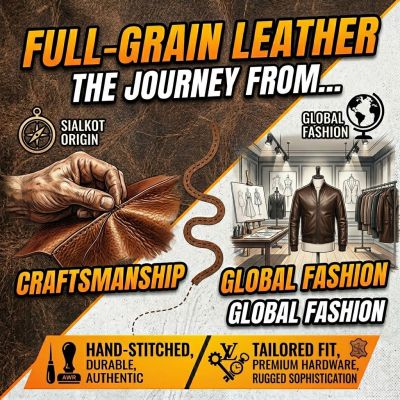
A full-grain leather jacket feels firm, slightly textured and heavy, and that character comes from how the hide is selected, tanned, cut and stitched. Sialkot, in Punjab, Pakistan, is known as a manufacturing hub for sports goods, surgical instruments and leather goods, according to the Wikipedia entry on Sialkot.
This guide explains what full-grain leather is, how leather garments are made in a production centre such as Sialkot and how to check leather before buying.
Key Takeaways
- Full-grain leather keeps the entire natural grain, with no surface removed by sanding or buffing, and develops a patina with use.
- "Genuine leather" does not describe a specific grade and often refers to heavily processed split leather.
- Hide selection, tanning, cutting and stitching each shape the finished jacket.
- Surface, labeling and seller information are the practical ways to check what a jacket is made from.
What Exactly Is Full-Grain Leather?
Labels such as "Genuine Leather", "Top-Grain" and "Full-Grain" appear on leather goods, and they describe very different things. As the Wikipedia overview of leather explains:
Full-grain leather contains the entire grain layer, without any removal of the surface. It is usually considered the highest-quality leather.
Corrected-grain leather has a finished surface: flaws are buffed or sanded away, then the surface is dyed and embossed for a uniform look.
Genuine leather does not describe a specific grade. It often indicates split leather that has been extensively processed.
The patina: full-grain leather develops a patina over its useful life instead of wearing out in the usual way. Small marks and pores stay visible because the surface is left intact.
Sialkot: A Leather and Sports Goods Hub
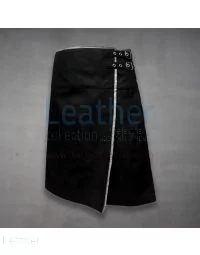
Sialkot is known for sports goods, surgical instruments and leather work, and its leather workers make garments such as German lederhosen pants. The steps below describe how a full-grain garment is made in general.
1. Selecting the Hide
The process starts with the hide. Because nothing is sanded away on full-grain leather, natural marks stay visible, so hide selection matters more than it does for corrected-grain leather that is finished to hide flaws.
2. Tanning
Tanning stabilizes the proteins of the raw hide, mainly collagen, which increases durability and prevents decay. How the leather is finished afterwards decides how soft, stiff or water-resistant it feels.
3. Hand-Cutting and Stitching
Cutting and stitching decide how a jacket hangs and how long its seams hold. A cutter reads the grain direction of the leather to place each panel, and strong seams matter on garments such as a or a . Leather Collection has made hand-stitched, made-to-order leather clothing since 2009.
From Workshop to Global Fashion
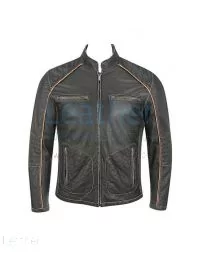
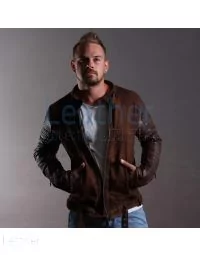
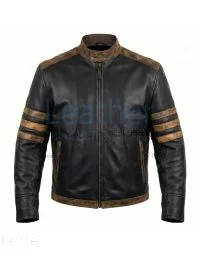
Full-grain leather suits garments meant to be worn for years, because the surface changes with use rather than being replaced by a coating. The look ranges from sleek city styles such as a to rugged vintage designs.
Examples of this kind of work include the .
How to Check Full-Grain Leather
Three practical checks help when comparing leather jackets:
Look at the surface: full-grain leather keeps its natural grain, with small pores and marks. A completely uniform, embossed pattern points to corrected-grain leather.
Read the label: "genuine leather" is not a grade, so it says little about quality. Look for the specific description, such as full-grain.
Ask about the leather and finish: the seller should be able to state the leather type, whether the surface is natural or corrected, and how it is finished.
For men's styles in different leathers, see the collection.
Choosing Leather With Confidence
Full-grain leather is a material choice rather than a brand promise: it keeps the natural surface, shows marks and pores and develops a patina. Understanding the grade labels, and the steps from hide to finished seam, makes it easier to compare jackets and to know what is being paid for.
Frequently Asked Questions
Is full-grain leather the same as genuine leather?
No. Full-grain leather keeps the entire grain layer without removing the surface. Genuine leather does not describe a specific grade and often indicates split leather that has been extensively processed. The two terms are not interchangeable, so the full description on the label matters when comparing jackets.
What is a patina on leather?
A patina is the change in surface character that full-grain leather develops over its useful life. Instead of wearing out in the usual way, the surface gains sheen and character from use. Corrected-grain leather has a finished, embossed surface, so it does not develop a patina in the same way.
Why does full-grain leather show marks and pores?
Because the surface is not sanded or buffed, the natural grain stays visible, including small marks and pores. These are part of the material rather than flaws to be removed. Corrected-grain leather, by contrast, is buffed and embossed to give a more uniform look.
Where is Sialkot and what is it known for?
Sialkot is a city in Punjab, Pakistan. It is known as a manufacturing hub for sports goods, surgical instruments and leather goods, and its leather workers make garments for export markets, including lederhosen pants for Germany according to Wikipedia.
Written by the Leather Collection Editorial Team.