
 USA
 Brazil
 Germany
 France
 Italy
 Switzerland
 Sweden
 Spain
 Great Britain
 Norway
 Russia
 South Africa
 Japan
 New Zealand
 Australia

Short answer: a small, clean tear in a sound leather jacket can often be fixed at home by gluing a soft backing patch behind it. Tears along a seam, in high-stress spots or in dry, cracked leather usually need re-stitching or a professional. Decide by the length of the tear, where it is and how healthy the leather around it looks.
This guide is only about tears, rips and holes. For scratches, scuffs and faded color, see our general DIY leather repair guide and the post on fixing scratches and fading.
Tear, rip or hole: read the damage first
Lay the jacket flat in good light and sort the damage into one of three types.
- Clean slit. A straight cut with neat edges, from a sharp edge or a zipper tooth. These repair best.
- Ragged tear. Torn fibers and uneven edges, usually from a snag or from stress. Harder to hide, but often repairable with a backing patch.
- Missing piece. A hole where leather has gone, from abrasion or a burn. Needs filler or an insert.
Then look at the leather around the damage. Flex it gently. If it is supple and the edges hold together, the repair has something sound to bond to. If it is dry, flaky or cracked, glue will not hold for long because the surrounding leather will keep tearing.
Which repair fits: glue, sub-patch, sewn patch or professional
| Damage and location | Best option | Realistic finish |
|---|---|---|
| Short clean slit in a flat panel (body, back) | Backing sub-patch with flexible adhesive | A faint line; often hard to see at arm's length |
| Ragged tear under 2 in (5 cm) away from seams | Sub-patch, then blend with color | Visible on close inspection |
| Tear at an elbow, shoulder or other flex point | Sub-patch plus professional advice | May reopen under repeated bending |
| Pocket corner tear | Sewn reinforcement from behind | Strong, mostly hidden inside |
| Hole or missing piece | Filler for small holes; insert or replacement panel for larger ones | Noticeable; color match is the hard part |
| Split seam | Re-stitch, not glue | Often invisible when done well |
| Cracked, dry leather around the damage | Professional assessment | Depends on the leather |
Fixing a small clean tear with a sub-patch
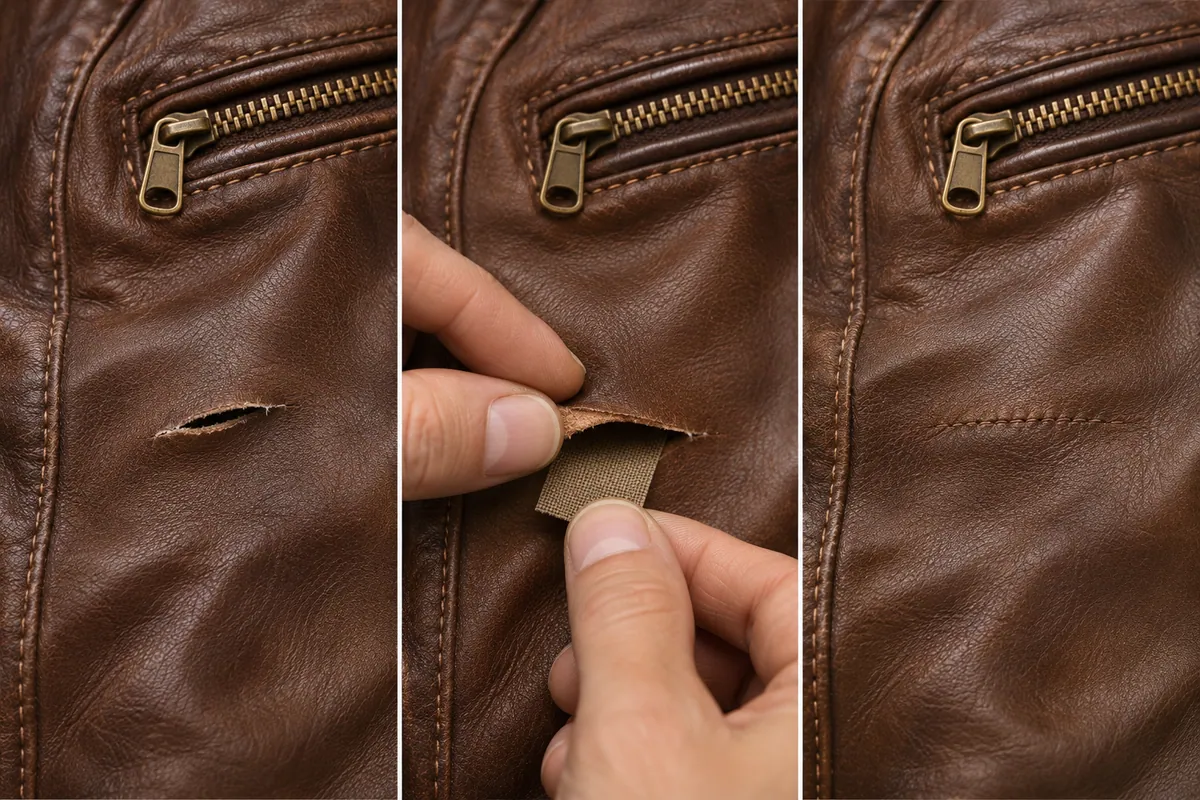
A sub-patch is a thin piece of soft backing, slid behind the tear and bonded to the underside. It supports the edges so they do not pull apart. Follow the manufacturer's instructions for your adhesive before you start, because products differ in cure time and flexibility.
What you need
- A piece of soft leather, thin lining fabric or canvas for the backing
- A flexible leather adhesive made for clothing leather, not a rigid household glue
- Small sharp scissors, tweezers and a toothpick or small spatula
- A heavy flat weight and baking parchment or wax paper
- Leather color or dye for blending, if you want to hide the line
Steps
- Open the lining if needed. Access the back of the tear through a seam or lining opening. If the lining is also torn, repair that first.
- Trim loose fibers. Snip stray threads of leather with small scissors so the edges meet cleanly.
- Cut the backing. Make it an inch (about 2.5 cm) larger than the tear in each direction, with rounded corners so it does not peel.
- Slide it in. Use tweezers to position the patch behind the tear, flat against the underside.
- Glue sparingly. Apply a thin layer of adhesive to the backing through the tear, then press the edges down so they meet without overlapping.
- Weight and wait. Place baking parchment on top, then the weight. Leave it for the full time on the adhesive label.
- Blend. Once cured, dab matching leather color along the line and let it dry.
Practice on an offcut or an old garment if you can. A thin bead of glue is better than a thick one, which will stiffen the area and show.
Repairing a hole or missing piece
When leather is missing, gluing the edges together is not possible, so you choose between three approaches.
- Filler. A flexible leather filler works for small holes in a flat area. It is built up in thin layers and tinted. It will feel and look slightly different from the surrounding grain.
- Insert. A piece of matching leather is cut to fill the hole and glued over a backing. Color and thickness matching decide how it looks.
- Replacement panel. For large damage, a tailor or leather specialist removes the damaged panel and sews in a new one. It is the most durable and the most expensive approach.
Be realistic about the result. A filled hole is a repair, not an erasure.
Seam splits are a different job
A seam that has opened is not a leather tear. The stitching has failed, and the leather itself is usually fine. Gluing across a seam is almost always the wrong fix, because the seam carries load and will pull apart again. The right repair is re-stitching along the original line with suitable thread, ideally through the same holes. From a maker's point of view, seam failures usually come from worn thread, overstuffed pockets or a too-tight fit, so it is worth checking why it opened. A jacket that is too small will split at the same place again.
When a repair is not worth it
- The leather around the tear is dry, thin or cracked, so a new tear will follow.
- The lining is also torn or the damage is on several panels.
- The jacket's value is lower than the cost of a good repair.
- The tear is in a visible, high-stress area, like the shoulder or elbow, and you need it invisible.
Ask a leather repair specialist for a quote before deciding, because prices depend on the garment and the damage. In some cases replacing the jacket is the sensible route, and a made-to-order maker can cut a new one to your measurements, so you are not stuck with a poor fit that caused the damage. Our custom leather jackets are made to order. Leather Collection does not offer repairs or panel replacement, so use a local leather specialist for those.
Aftercare so it does not tear again
- Condition the leather lightly when it feels dry. See our guide to cleaning and conditioning a leather jacket.
- Do not overstuff pockets or hang heavy bags from one shoulder.
- Reinforce stress points like pocket corners with a small stitched patch inside.
- Make sure the fit is right. A tight jacket strains seams and leather, and a new jacket that is stiff may just need breaking in.
FAQs
Can you glue a tear in a leather jacket?
Yes, a small clean tear can be bonded with a flexible leather adhesive, ideally over a backing patch. Gluing alone rarely holds in stressed areas or along seams.
How much does it cost to repair a leather jacket tear?
It depends on the size, location and the repairer, so get a quote. A small patch is generally a smaller job than a replaced panel. We do not quote prices here.
Can a ripped leather jacket be repaired invisibly?
Sometimes a small clean slit can be made very hard to see. Larger tears and holes are usually visible up close, because the grain and color are hard to match perfectly.
Is super glue safe on leather?
It is not recommended. Cyanoacrylate glue dries hard and brittle, stiffens the leather and can crack or darken it. Use a flexible adhesive made for leather and follow its instructions.
How do you fix a hole in a leather jacket sleeve?
A sleeve flexes constantly, so a small hole may need an insert over a backing patch, and larger damage may need a replacement panel from a professional. Sleeves are harder to repair at home than flat panels.
Can you repair a torn leather lining?
Yes. A lining is usually fabric and can be hand-stitched or replaced. Repair it first if the shell tear needs access from the inside.
If your jacket is beyond a simple fix, browse our custom leather jackets, made to your measurements in the leather you choose, or compare styles in our men's leather clothing.