 USA
 Brazil
 Germany
 France
 Italy
 Switzerland
 Sweden
 Spain
 Great Britain
 Norway
 Russia
 South Africa
 Japan
 New Zealand
 Australia

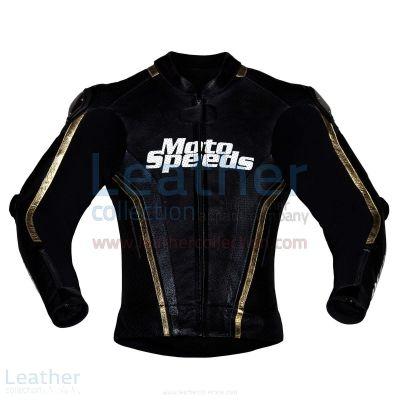
A custom motorcycle jacket changes three things an off-the-shelf one cannot: how it fits the rider, how it carries protection, and which details it shows. The , available at Leather Collection, is offered as a customizable jacket, and this guide covers what to decide before ordering one.
Leather Collection has made leather riding gear since 2009, hand-stitched and made to order, so most of the choices below are made before the first panel is cut.
Key Takeaways
- Custom sizing matters most where standard cuts fail: sleeve length, torso length and armour position.
- The Whiz Tech product page lists drum-dyed cowhide of 1.2 to 1.3 mm, pre-curved sleeves and removable shoulder and elbow protectors listed as CE Level 2 to EN 1621-1:2012; no garment class is stated, and the order form also offers CE Level 2 as an add-on, so check the option chosen.
- EN 17092 classes the garment; EN 1621 describes the armour inserts. They are separate things.
- Ventilation, lining and back protector choices should follow the climate and the kind of riding.
The Case for Customization
Standard sizing is built around an average body, so sleeves that suit one rider run short for another and armour can sit a few centimeters off the joint it is meant to cover. A made-to-measure jacket addresses this directly: the garment is cut to the rider's dimensions and riding position instead of the rider adapting to the garment.
What Can Be Tailored
- Fit: sleeve and body length, so the armour sits over the shoulder and elbow when the rider is on the bike.
- Graphics: the product page of the made-to-measure jackets listing mentions names, numbers and logos; the Whiz Tech page does not list graphics options, so ask before assuming they are available.
- Ventilation and lining: perforated panels for hot weather, or a removable lining for cooler riding, depending on the options offered on the product page.
Materials and Construction
The Whiz Tech product page describes drum-dyed cowhide leather of 1.2 to 1.3 mm, pre-curved sleeves, stretch panels at the sleeves and calves, and a polyester mesh lining. Abrasion performance depends on the leather, the seams and the construction; the EN 17092 class on a garment label is the test-based indicator, and the product page states none.
Protection: What the Standards Say
Two standards are often mixed up. EN 17092 grades whole garments into classes AAA, AA, A, B and C, with elbow, shoulder, knee and hip impact protectors mandatory in Classes AAA and AA (hip protectors optional in Class A), Class B giving the abrasion protection of Class A without impact protectors, and Class C covering impact protection only, as set out by test house SATRA. EN 1621-1 covers the removable armour itself: Level 1 requires a mean transmitted force below 35 kN with no single value over 50 kN, as SATRA describes, and Level 2 sets a lower mean limit, below 20 kN.
The product page lists removable shoulder and elbow protectors listed as CE Level 2 to EN 1621-1:2012 and a removable spine/back protector described as EN 1621-2 compatible, without a level for the back protector or a named test certificate. The order form also offers CE Level 2 (EN 1621-1:2012) as an add-on, so the armour level depends on the option chosen and the order form should be checked. No garment class is stated. Riders comparing layouts can look at a , whose product page lists CE-rated armour at the elbows and a removable rain liner, or at a , whose page describes a built-in back support panel for comfort and structural support and does not list armour.
Comfort on Long Rides
A is only as good as its comfort over a long ride. Pre-curved sleeves follow the arm position on the handlebars, which reduces the leather bunching at the elbow, and a mesh lining helps with moisture. For riders who need a closer look at made-to-measure options, the range shows the kinds of adjustments available.
Final Thoughts
A custom build suits riders whose proportions fall outside standard sizing. The decision points are fit, armour position, back protection and ventilation. Read the product page for the exact specification before ordering.
Frequently Asked Questions
Is a custom motorcycle jacket safer than a standard one?
Not automatically. A tailored fit helps armour sit over the shoulder and elbow while riding, but how it behaves in a crash depends on the whole garment, and protection still depends on the leather, the seams and the armour inserts. Check the garment classification and the armour standard listed on the product page rather than assuming that customization adds safety.
What does CE Level 2 armour mean?
CE here refers to impact protectors tested to EN 1621-1, the European standard for shoulder, elbow, knee and hip protectors. For these limb joint protectors, Level 2 is the stricter of the two levels: the mean force transmitted in the test must stay below 20 kN , against below 35 kN and 50 kN for Level 1. The level describes the insert alone, not the whole garment, and not every crash outcome.
Can a back protector be added to a race-style leather jacket?
Some jackets list a removable spine or back protector. The Whiz Tech product page lists one described as EN 1621-2 compatible and does not document whether the jacket accepts a different insert, so the maker should be asked before any other protector is fitted. EN 1621-2 is the standard for back protectors; it has its own Level 1 and Level 2 limits, which cannot be compared with the limb-protector figures because the tests and set-up differ, and a lower figure for one protector type does not make it safer than the other.
How should a motorcycle jacket fit?
A riding jacket should be snug enough that the armour does not shift, yet allow full movement of the arms when reaching for the bars. Sit on the bike or mimic the riding position when trying it on: sleeves should not ride up, and the shoulders should stay in place. Leather loosens slightly with wear, so a slightly firm fit is normal.
Written by the Leather Collection Editorial Team.