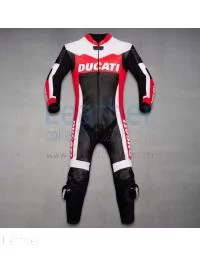
 USA
USA  Brazil
  Germany
  France
  Italy
Italy  Switzerland
  Sweden
  Spain
Spain  Great Britain
  Norway
  Russia
  South Africa
  Japan
Japan  New Zealand
  Australia
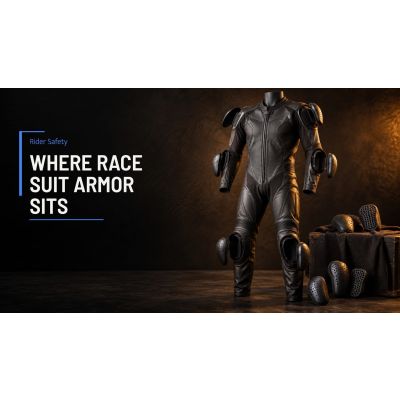
Armour protects only the part of the body it covers at the moment of impact, so two things decide how much the armour in a race suit can do: whether each protector sits over the joint it was made for, and whether the protector itself was tested against a recognized standard. Placement is a question of fit and construction. Certification is a question of testing and documentation. A tested protector that sits two fingers away from the knee leaves the knee exposed, and a well-placed protector with no test behind it leaves the rider guessing about the force it lets through.
This guide explains where protectors belong in a leather race suit, why placement shifts, how the main European standards divide the work, and what to check before a suit is ordered or ridden. It describes standards in general terms; the armour in any specific suit should be confirmed from that suit's product page and order form.
Key Takeaways
- Protectors belong over the shoulders, elbows, hips and knees, with a back protector as a separate item covered by its own standard.
- A protector only helps if it stays over the joint during a slide, so suit fit matters as much as the armour itself.
- EN 1621-1 tests limb joint protectors at Level 1 or Level 2; EN 17092 sets garment classes and requires protectors to cover the right body part.
- A standard describes how a protector is tested; it does not describe a particular suit. Ask for documentation for the exact armour option.
- Check placement in a riding crouch with the suit on, not standing upright.
Where Armour Sits in a Race Suit
A race suit uses leather for abrasion resistance and relies on separate impact protectors for the joints and bones that take the hardest hits. The usual zones are the shoulders, elbows, hips and knees. Wikipedia's overview of motorcycle armour describes basic protective jackets as carrying shoulder and elbow armour, with pants covering the hips and knees, and it notes that EN 1621-1 addresses limb joint protectors for exactly those four areas.
Shoulders and elbows
Shoulder protectors sit over the point of the shoulder, where the collarbone and shoulder joint meet the arm. Elbow protectors sit over the elbow. Both depend on the sleeve length being right: if the sleeve is too long, the elbow cup rides toward the wrist when the arm is bent, and if it is too short, the cup rides up toward the shoulder.
Hips and knees
Hip protectors sit over the hip bone at the side of the pelvis, and knee protectors over the kneecap and the sides of the joint. In a suit, the trouser section is cut for a riding posture, so the knee position changes noticeably between standing and crouching. This is the zone where a protector most often ends up lower or higher than intended, and it is the main reason a fitting should be checked with the knees bent.
Back and chest
The spine is protected by a back protector, which has its own standard. According to SATRA, EN 1621-2 accommodates three types: full back, central back and lower back (lumbar) protectors. Wikipedia lists EN 1621-3 as the part covering chest protectors. Whether a particular race suit has a pocket for a back protector, and which protector fits it, is a product-level question to answer from the product page and order form.
Why Placement Matters as Much as the Armour
Impact protectors are tested on a rig, with the sample held in a fixed position under a striker. On a rider, the protector has to find the joint every time, through a lean, a tuck and a slide. The test result for the protector says nothing about whether the garment holds it in the right place. That job belongs to the suit's construction: the pocket or attachment, the cut of the sleeve and leg, and the fit through the body.
The standards reflect this. According to a SATRA article on testing motorcyclists' protective equipment, EN 17092 includes performance requirements for protector restraint, meaning how well the garment holds the protector. SATRA's EN 17092 page adds that protectors must be positioned in the garment so they cover the appropriate body part, as set out in the relevant impact protector standard.
What makes protectors drift
- A suit that is too large, so the whole garment slides on the body while the rider moves.
- Sleeves or legs that are cut for the wrong height, which puts the elbow or knee cup off the joint.
- Stretch in worn leather and linings, which changes how the garment sits over time.
- Protector pockets that are loose, so the armour can slide inside the pocket.
- Riding posture that differs from the posture used when the suit was measured or tried on.
Because a made-to-order suit is cut from measurements, accurate numbers are what put the armour in the right place. Arm length, inseam, torso length and height all influence where the elbow, knee and hip protectors land, and the guidance on how to measure on the order form deserves care for that reason. Browsing the makes it easier to compare cuts, and for any of them the cut is only as good as the measurements behind it.
What the Main Standards Cover
Three standards come up most often when race suit armour is discussed. They answer different questions, which is why they are easy to mix up.
| Standard | What it covers | What it tells a rider |
|---|---|---|
| EN 1621-1 | Limb joint impact protectors: shoulders, elbows, hips, knees | How much force a protector transmits in the test, at Level 1 or Level 2 |
| EN 1621-2 | Back protectors (full back, central back, lower back) | A comparable force-transmission test applied to back protectors, at Level 1 or Level 2 (figures differ from EN 1621-1) |
| EN 17092 | Whole garments, in classes AAA, AA, A, B and C | Garment-level requirements, including that protectors cover the right body part |
EN 1621-1 and EN 1621-2 levels
For limb protectors, SATRA gives Level 1 as a mean transmitted force below 35 kN with no single value over 50 kN, and Wikipedia gives Level 2 as a mean below 20 kN. SATRA's EN 1621 page states that the lower the force a protector transmits, the more protective it is considered to be. For back protectors, Level 2 allows a lower transmitted force than Level 1. The two parts use different test setups, so the figures for limb and back protectors are not interchangeable.
EN 17092 classes
According to SATRA's EN 17092 page, the standard has five garment classes: AAA, AA, A, B and C. Elbow, shoulder, knee and hip protectors are mandatory in Class AAA and AA garments, and hip protectors are optional in Class A. Class B garments have no impact protectors, and Class C garments are designed to provide impact protection only for the areas covered by the protectors and do not offer a minimum level of abrasion protection; they are special under- or overgarments. The class describes what the garment is required to include and withstand; it is not a statement about which type of riding a suit suits.
Certification: The Standard Is Not the Suit
A standard describes a test. It does not describe every suit that uses a protector. Three separate questions apply to any race suit, and each needs its own answer.
- Has the protector itself been assessed under EN 1621-1 or EN 1621-2, and at which level?
- Does the garment hold that protector over the correct body part?
- Is there documentation for the exact combination in the suit being ordered?
Armour details vary by product. For that reason, the product page and order form are the place to read which armour option applies, and it is reasonable to ask for the documentation that goes with it before ordering. Marketing shorthand such as "CE armour" does not say which part of EN 1621 or which level is meant, so a vague label is worth a follow-up question rather than an assumption.
A tested protector also does not make any outcome certain. Standards measure the force a protector transmits in a controlled test; real crashes vary widely in speed, angle and surface. Protectors reduce the load on the body in the zones they cover, and the rest of the rider still depends on fit, leather construction and the wider kit.
How to Check Placement When Fitting a Suit
Armour placement is easy to check with the suit on, and it does not require special equipment. The checks are easier with a helper who can look at the back and sides.
- Put the suit on fully, close every zip and adjust every fastening as it would be for riding.
- Stand upright and note where each protector sits relative to the shoulder point, elbow, hip bone and kneecap.
- Move into a riding crouch with the arms forward as if holding the bars, and check again. The elbow cup should still sit over the elbow and the knee cup over the knee.
- Bend and straighten the arms and legs several times. Protectors that slide a long way and do not come back are not being held well.
- Press on each protector through the leather. It should feel stable in its pocket and should not fold or bunch.
One-piece and two-piece suits
A is a single garment from shoulder to ankle, so it holds the upper and lower protectors in a fixed relationship to each other. A two-piece suit joins a jacket and pants at the waist, and that join is one more place to check in a crouch: if the jacket rides up, the hip and back protectors can ride up with it. Riders weighing the two layouts can compare a with a standard one-piece cut, keeping the same placement checks in mind for both.
Different body proportions
Protector positions follow the body, so a suit cut for one build will not put armour in the right place on another. Men's and women's patterns generally differ in torso length, hip width and shoulder width, so the size chart and measurement guidance for each range matter, whether the and the are chosen. The same applies within each range: two riders of the same height can need different sleeve and leg lengths.
Questions to Ask Before Ordering a Suit With Armour
Armour details vary by product, so the answers below come from the product page, the order form and the documentation for the option chosen, not from the style name of the suit. A rider who has thought these through before ordering is better placed to read what comes back.
- Which protector is offered for each zone, and which standard and level does its documentation name?
- Is the back protector a separate item, and does the suit have a pocket cut for it?
- How are the shoulder, elbow, hip and knee protectors held inside the suit?
- Which measurements affect the armour position, and how should they be taken?
- Can the documentation be provided before the order is placed?
Team-style and rider-inspired suits follow the same logic as any other suit. The is a styling choice first. Its product page lists removable armour at the knees, shoulders and elbows, a removable spine protector and CE Level 2 as a listed add-on, and it still needs the same armour and measurement questions answered before the graphics are considered.
Frequently Asked Questions
Does armour that meets EN 1621 make a crash safe?
No. EN 1621 describes how much force a protector transmits in a controlled test, and a lower figure is considered more protective. A real crash varies in speed, angle and surface, and the protector only works over the area it covers. Placement, garment fit and the abrasion performance of the leather all affect the outcome, so a test level is one factor among several.
What is the difference between Level 1 and Level 2 armour?
Both levels come from the EN 1621 standards, and Level 2 allows a lower transmitted force than Level 1 in the test. For limb protectors, SATRA gives Level 1 as a mean below 35 kN with no single value over 50 kN. The level belongs to the protector, so check which level the armour option for a given suit names in its documentation.
Can armour be moved or swapped to sit better?
Protectors that are held in pockets can sometimes be repositioned or replaced, but the right answer depends on the suit. A protector that has to be moved to sit correctly often points to a fit problem in the sleeve, leg or torso length. Ask the maker how the protectors are held and which replacements suit that construction before changing anything.
Is a back protector part of the suit?
The spine is covered by a separate standard, EN 1621-2, which describes full back, central back and lower back protectors. Whether a particular suit includes a back protector or only a pocket for one is a product-level detail. Check the product page and order form for the armour option, and ask for the documentation that applies.
Written by the Leather Collection Editorial Team.