 USA
 Brazil
 Germany
 France
 Italy
 Switzerland
 Sweden
 Spain
 Great Britain
 Norway
 Russia
 South Africa
 Japan
 New Zealand
 Australia

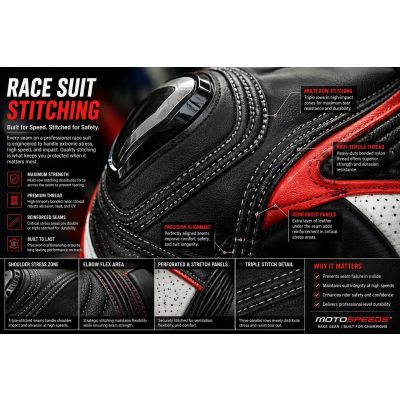
Most riders choosing a motorcycle race suit focus on fit, colour and armour placement. Stitching gets less attention, yet the seams decide whether a suit stays in one piece during a slide. Understanding how race suit stitching works makes it easier to compare suits and to ask the right questions before buying.
Key Takeaways
- Seams hold the leather panels and the armour together; a seam that opens exposes the rider and lets armour move.
- EN 17092 tests abrasion, seam strength and tear strength on the finished garment; armour is tested separately under EN 1621.
- Some suits use multiple rows of stitching on high-stress seams; the number is not part of the class label and should be checked per suit.
- Fit affects seams: a suit that is too tight or too loose stresses stitching and shifts armour.
- Seams and armour should be inspected after any crash, even if the suit looks intact.
Quick Answer
Stitching in a race suit keeps the leather panels joined and the armour positioned over the joints. Seam strength, tear strength and abrasion resistance are tested under EN 17092, and armour is tested under EN 1621. Before buying, check the EN 17092 class on the label, look closely at seams around the shoulders, elbows, knees and armour pockets, and confirm that the suit fits in the riding position.
What Stitching in Race Suits Means for Rider Safety
Stitching is the thread that holds a leather race suit together. In a slide the leather has to resist abrasion, and the seams have to stay closed so the suit does not open up and expose skin. Stitching also keeps armour panels and pockets attached, so protectors stay over the joints they cover.
The garment standard is EN 17092. According to SATRA's overview of EN 17092, it defines five classes, AAA, AA, A, B and C, with AAA offering the highest level of protection from impact and abrasion. It divides a garment into three risk zones and tests abrasion on a Darmstadt machine, where a hole of 5 mm or more in any direction on the layer closest to the body is a failure. Tear strength and seam performance are tested as well. The class therefore describes the whole garment, including its seams.
Armour is covered separately. As SATRA explains, EN 17092 refers to the relevant part of EN 1621 for the protectors, and limb protectors under EN 1621-1 come in Level 1 and Level 2. Stitching and armour are different safeguards that depend on each other: strong seams without armour leave the joints exposed, and good armour in a suit with weak seams can move or be left behind.
Why Seam Quality Matters on the Track and the Road
On the track a suit works through constant leaning, braking and acceleration, and a seam that begins to fail can open in a crash. On the road the stresses are different: longer rides, heat, repeated flexing and the unpredictability of traffic. In both cases seams must carry load that the leather transfers to them.
Stitching also keeps armour from shifting. During a slide, protectors need to stay centered over elbows, knees, shoulders and back. Seams around the armour pockets are therefore worth examining as closely as the leather seams.
Riders comparing suits for road use can browse
and check seam construction and armour placement on each model.Heat, sweat and sunlight age materials over time, and thread is no exception. Regular inspection of seams, especially at stress points such as the shoulders, knees and seat, catches wear early.
How Reinforced Stitching Protects During a Crash
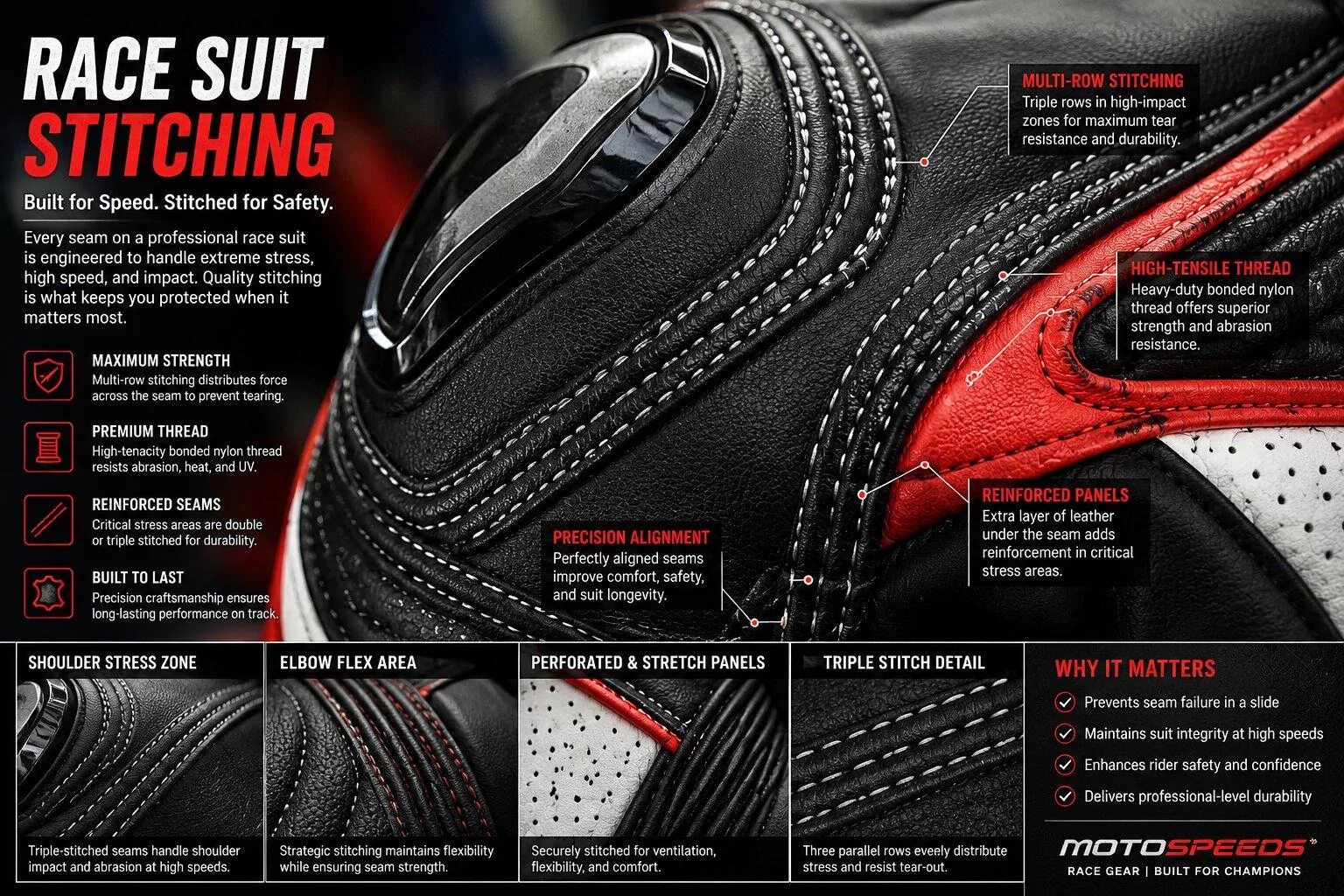
When a rider crashes, the suit meets the ground first. The leather wears under friction and the seams come under heavy tension as panels try to pull apart. Reinforced stitching resists that tearing: several rows can spread the load across more thread.
Some race suits use more than one row of stitching on high-stress areas such as the shoulders, elbows, knees and hips. Whether a seam holds is what the EN 17092 seam test assesses on the finished garment, so the label and construction details matter more than the row count alone.
Stitching also keeps layered panels bonded. If stitching fails, reinforcement layers can separate, which reduces abrasion resistance and lets armour shift.
No protective gear removes the risk of injury in a crash, and a high-speed crash can still cause harm. Fit, correct armour placement and riding behaviour all matter alongside the stitching.
What Riders Should Check Before Buying a Race Suit
Inspecting the stitching in person is the most reliable check. For online purchases, detailed photos of the seams are a reasonable request. Useful details to look at:
Seam rows: Compare how many rows of stitching run along the shoulders, elbows, knees and centre back across different suits. The count differs between designs and is not part of the class label, so it is a question to put to the maker.
Seam placement: Seams should be tight and even, without loose thread or gaps, and placed around armour panels and areas that see the most abrasion. Uneven stitching deserves a closer look.
Thread: The thread should be even and consistent, without fraying. The thread type is worth asking about, since the maker can say what is used.
Armour stitching: Look at how armour panels and pockets are attached. Loose or thin stitching around the armour may allow protectors to move in a crash.
EN 17092 class: Check the label for the class and what it covers. A class applies to a specific garment, so the product details should state it. For example, riders choosing suits for track use can compare options in against the label of each model.
Fit and movement: Poor fit stresses seams. A suit that is too tight keeps seams under constant tension, while one that is too loose shifts and causes flexing at the seams. A closer fit also keeps armour in the right position, and made-to-measure sizing is worth considering when standard sizes do not suit the rider's build.
Common Mistakes About Stitching and Seams
Mistake 1: Assuming visible stitching is always structural. Some stitching is decorative. Asking where the structural seams are and how they are built avoids confusion.
Mistake 2: Ignoring seams during the fitting. A suit can fit well across the chest and arms but pull or bunch in the riding position. Moving through the riding position, and sitting on a bike if possible, shows seams that pucker or pull; these tend to wear sooner.
Mistake 3: Assuming one row of stitching is the same as several. Multiple rows can spread the load across more thread. Where a suit is intended for track or fast road riding, the stitching on critical seams deserves more scrutiny.
Mistake 4: Not checking armour attachment. Riders often look at the leather seams and overlook how armour is held. If the armour stitching is weak, the armour can shift in a crash and leave the joint exposed.
How Fit, Comfort and Stitching Work Together
Stitching only does its job if the suit fits. A poorly fitted suit stresses seams in unexpected ways: seams that should be relaxed become stretched, which speeds wear.
A good fit means the suit moves with the body without excess material. On the bike, a rider should be able to lean, grip the tank with the knees and move the arms freely without seams pulling or twisting.
Comfort matters for protection too. An uncomfortable suit tends to be worn open or loose, and loose gear lets armour shift. A suit works only when it is worn properly every time, so stitching and fit have to be considered together.
Made-to-measure sizing can improve both fit and seam stress, since the suit is cut for the rider's own measurements and keeps the armour aligned.
Final Buying Advice for Race Suits
Stitching quality deserves attention alongside armour and material when choosing a suit.
Compare seam construction. Look at several suits side by side and read the product descriptions to see how each is built. Browsing is a practical way to compare constructions.
Check certifications. Verify the EN 17092 class on the label and the EN 1621 level on the armour. A rating does not mean a suit is right for every type of riding.
Ask for detail. Questions about thread, stitching technique and armour attachment are reasonable, and the answers should be specific.
Consider made-to-measure. Standard sizes suit many riders, but an unusual build benefits from a suit cut to its own measurements.
The
is one suit to examine for seam construction, armour placement and fit, and offers another example to compare.Inspect gear after a crash. A suit that looks intact may have damaged seams that are not visible. After any crash, a specialist or the manufacturer should inspect it, and the maker's inspection and repair guidance should be followed.
Frequently Asked Questions
How many rows of stitching should a race suit have?
There is no single number, and the row count is not part of an EN 17092 class label. Some race suits use more than one row on high-stress seams such as the shoulders, elbows and knees, because extra rows can spread the load across more thread. The product details or the maker should show where reinforced stitching is used on a particular suit.
What does EN 17092 mean for stitching?
EN 17092 is the European standard for motorcycle protective clothing. It tests abrasion resistance, tear strength and seam performance on the finished garment and rates it in classes from AAA to C. It does not replace armour testing: impact protectors are tested separately under EN 1621, so both the garment class and the armour level should be checked on the label.
Can weak stitching cause armour to shift in a crash?
Yes. Armour that is attached with weak stitching or loose pockets can move away from the joint it is meant to cover. The aim of certifying protectors with a garment is that the protector does not move from the area it protects, so seams around armour deserve the same attention as the leather seams.
Should a race suit be repaired or replaced after a crash?
After any crash, the suit should be inspected by the manufacturer or a specialist, because internal seam damage is not always visible. Follow the manufacturer's inspection and repair guidance; many makers recommend replacing protective gear that has been in a crash or has damaged structural seams.
Can good stitching be judged by looking at a suit?
A close look gives a first impression: even, tight stitching without loose threads or gaps, and clear attachment of armour pockets. Thread type and internal construction are harder to see, so details from the manufacturer, such as seam placement and materials, add useful information.
Conclusion
Stitching affects how well a suit holds together and keeps armour positioned; check construction and label details. Knowing how reinforced stitching works, what to check when buying and how fit affects seams supports better decisions about protective gear.
When comparing suits, examine the seams, check how armour is attached, ask about construction and read the EN 17092 class and EN 1621 armour level on the label. Together with a suit that fits properly, these checks give a clear picture of how a suit is made.
Written by the Leather Collection Editorial Team.