 USA
USA  Brazil
  Germany
  France
  Italy
Italy  Switzerland
  Sweden
  Spain
Spain  Great Britain
  Norway
  Russia
  South Africa
  Japan
Japan  New Zealand
  Australia
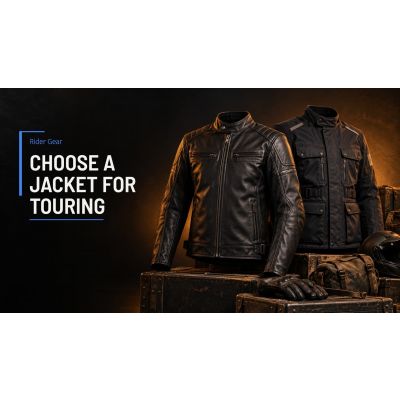
A good touring jacket is the one that stays comfortable across a full day in the saddle, in changing weather, while still carrying proper impact protection and abrasion resistance. Leather and textile can both do that job, so the choice comes down to climate, how much weather you ride through, and how much fuss you want with liners and layers. This guide covers what to check on either type before you buy.
Key Takeaways
- Touring comfort depends on fit, ventilation and weather handling as much as on the outer material.
- Leather is thicker and stronger; textile jackets usually offer more weather protection and more vents and pockets.
- Check that shoulder and elbow armour is present and sits correctly, and ask about the back protector option.
- Look for an EN 17092 class label and read what that class means before relying on it.
- Fit the jacket with your riding layers and in the riding position, not standing upright.
Leather vs Textile for Touring
Both materials are used for touring jackets, and neither wins every comparison. According to Wikipedia, protective leather is thicker, stronger and only moderately flexible, while textile jackets commonly use high-density nylon such as Cordura and are often valued for weather protection and for the pockets and vents they offer. Waterproof liners are a common feature on textile jackets.
| Factor | Leather jacket | Textile jacket |
|---|---|---|
| Material | Thicker and stronger, moderately flexible | Woven synthetics such as ballistic nylon |
| Weather handling | Usually depends on a separate liner or layers | Often built around waterproof and thermal liners |
| Ventilation | Perforation or zip vents on some designs | Vents are common |
| Pockets and storage | Varies by design | Often extensive |
| Appearance over time | Develops its own character with wear | Stays consistent until it is worn through |
| Care | Follow the care label for the leather finish | Follow the care label for fabric and liner |
Leather types also differ from one another. The same source notes that full grain, top grain, corrected grain and suede can resist abrasion to different degrees, so the hide and finish matter as well as the word "leather".
Protection: What to Check on Any Touring Jacket
Armour in the right places
Armour and the jacket's abrasion-resistant outer layer do different jobs: protectors manage impact, while the outer layer and seams resist sliding. Armour only helps if it sits over the shoulder and elbow when you are in your riding position. Pull the jacket on, reach for imaginary bars, and check that the pads do not slide away from the joint. Back protection is often a separate option, so look at the product page and order form for the armour choices and ask for the documentation for whatever you select.
Understanding EN 17092 classes
EN 17092 is the European standard for motorcycle protective clothing, with garment classes AAA, AA, A, B and C. As SATRA explains, impact protectors at the elbow, shoulder, knee and hip are mandatory in Class AAA and AA garments, and hip protectors are optional in Class A. Class B garments aim for Class A-level abrasion protection without impact protectors, and Class C garments only provide impact protection where the protectors sit and are meant to be worn with other garments. A class label is a starting point, not a verdict: read the label and the documentation, and match them to the garment you are actually holding.
Armour levels (EN 1621)
Armour is tested separately. EN 1621-1 for limb protectors sets maximum transmitted-force limits. Level 1 requires the mean transmitted force to stay below 35 kN with no single value over 50 kN (SATRA's summary of EN 1621). Level 2 limits the mean transmitted force to below 20 kN, lower than Level 1. The same summary covers back protectors under EN 1621-2, where Level 2 is again the stricter level.
Fit and Comfort on Long Days
Fit on a touring jacket differs from fit on a fashion jacket. Try it on with the layers you plan to wear underneath and sit in a riding posture. The sleeves should stay long enough when your arms are extended, the back panel should cover the kidney area, and the collar should close without choking you. A jacket that feels slightly snug standing up often feels right on the bike, because leather relaxes with wear.
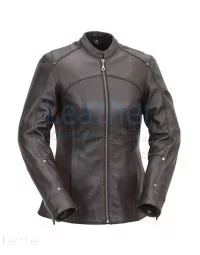
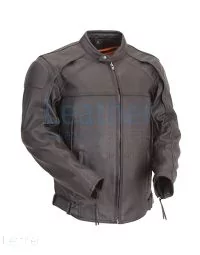
Longer cuts help on a long ride because they cover the lower back when you lean forward. A is one example of a longer-cut leather style, and riders who want something shorter and closer to the body can compare it with a .
For tailored options by gender, the shop is organized into a and a .
Weather, Layers and Ventilation
Touring means weather. Textile jackets often arrive with waterproof and thermal liners, which makes them simple to adapt as conditions change. Leather jackets handle changing temperatures through layering and removable liners, and many riders pair them with a separate rain layer for wet days. The product page for these describes a winter jacket and lists a zip-out insulated liner, which is the kind of detail worth checking: confirm whether the liner is removable and whether the jacket still leaves room for a base layer and a mid layer.
Ventilation matters just as much in summer. Zip vents, perforation panels and mesh sections let air through, but every opening is also a place where the weather can get in, so decide how much heat you expect to deal with before choosing vents over a solid shell.
A Quick Buying Checklist
- Decide the weather range you ride in, and whether a liner or separate rain layer suits you.
- Confirm shoulder and elbow armour is included or selectable, and ask about the back protector.
- Read the EN 17092 class on the label, if any, and what it covers.
- Check the fit in a riding posture with the layers you will wear.
- Look at pockets, collar, cuffs and adjusters that you will use every day.
- Read the care label and follow the maker's instructions for the leather or fabric.
Frequently Asked Questions
Is a leather or textile jacket better for touring?
Neither is better in every case. Leather is thicker and stronger, while textile jackets are often chosen for weather protection, vents and pockets. Rider climate, how much rain you meet and how you like to layer usually decide it. Armour, fit and the garment's documented class matter more than the material name alone.
What does EN 17092 class mean on a jacket?
EN 17092 divides motorcycle garments into classes AAA, AA, A, B and C. Impact protectors are mandatory at the elbow, shoulder, knee and hip in AAA and AA, while Class B has abrasion protection without impact protectors and Class C is impact protection only. Read the label and documentation for the specific jacket.
Does a touring jacket need a back protector?
Back protectors are often a separate option rather than part of the jacket. EN 1621-2 covers them, with Level 2 stricter than Level 1. Check the product page and order form for the armour options, and ask for the documentation of whichever armour you choose.
How should a touring jacket fit?
Fit it with your riding layers and in the riding position. The sleeves should stay long enough with arms forward, the back should cover your lower back when you lean, and the armour should sit over the shoulders and elbows without sliding. A little snugness off the bike is normal for leather.
Written by the Leather Collection Editorial Team.