 USA
USA  Brazil
  Germany
  France
  Italy
Italy  Switzerland
  Sweden
  Spain
Spain  Great Britain
  Norway
  Russia
  South Africa
  Japan
Japan  New Zealand
  Australia
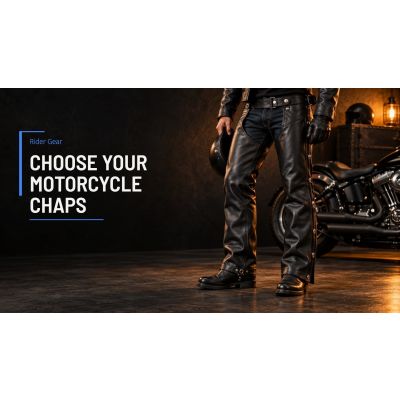
The motorcycle chaps worth buying are the ones that match how and where the rider uses them: a cut that suits the bike, leather thick enough for the job, a waist and leg fit that stays put at speed, and honest information about what protection the pair does and does not offer. Chaps are an over-garment, so they sit on top of pants or jeans rather than replacing them. This guide covers the decisions in the order they usually matter, so a buyer can compare styles without relying on a single "best" label.
Key Takeaways
- Chaps have no seat and are worn over pants, so they add a leather layer to the legs but are not a full riding pant.
- The cut (straight shotgun or flared batwing) changes how easily they go on over boots and how much air moves around the leg.
- Leather weight and finish matter more than the label on the hang tag; stiffer, thicker hide is less flexible.
- Ask for written documentation before assuming any protection level, and check the care label before cleaning.
What motorcycle chaps are and what they are for
Chaps are leather leg coverings made as two separate legs fastened to the waist with a belt or straps. They have no seat, which is the main feature separating them from pants. The design grew out of Mexican and Spanish riding gear for horses, and the shortened English name comes from the Spanish chaparreras. According to Wikipedia's article on chaps, they have also been adopted by motorcyclists, particularly cruiser riders, as protection from wind and cold.
That history explains the practical appeal. Chaps go on and off over regular pants, so a rider can wear them for a ride and remove them at the destination. Leather also adds a layer between the leg and the road, the wind and the engine heat. What they do not do is cover the hips and seat, which is worth remembering when comparing them with a full pair of .
Choose the cut: shotgun, batwing and other styles
The cut decides daily comfort more than almost any other feature. The two styles most riders meet are:
| Style | Leg shape | Typical advantage | Trade-off |
|---|---|---|---|
| Shotgun | Straight, narrow legs, usually with a full-length zipper on the outside | Close fit, little fabric to catch in the wind | Boots must be taken into account when sizing the zipper opening |
| Batwing | Wide legs that flare below the knee | More air circulation and easier to put on | More leather moving in the airflow at speed |
Other western styles exist, such as armitas and half-length chinks with long fringe. For riding, a long, fitted leg that runs down over the boot is the usual choice. A rider on a cruiser with a relaxed seating position often favors an easy-on cut, while someone leaning forward on a sport-style bike usually wants a slimmer leg that stays flat against the shin.
Leather type, weight and finish
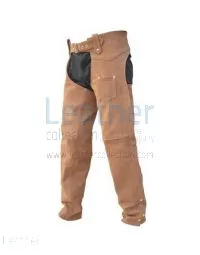
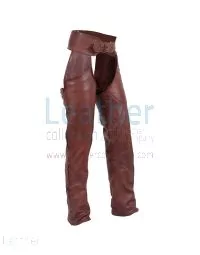
Leather is the main material in chaps, and its character varies with the animal, the tanning and the finish. Cowhide is a common material for chaps. Distressed or antique finishes soften the look, and , which the product page lists as distressed cowhide with a side zipper and snap closure, show how finish changes the appearance of the same base material.
Motorcycle protective leather is different from fashion leather. As the Wikipedia article on motorcycle personal protective equipment describes it, protective leather is thicker and stronger than fashion leather and only moderately flexible, and kangaroo leather is valued for being supple and light compared with cowhide. For a buyer, that means thickness and flexibility pull against each other: a heavier hide is stiffer when new, while a thin, soft hide is easier to wear but gives a different feel and level of toughness.
Questions to ask about the hide
- Is the leather full-grain or has the surface been corrected or coated? Coatings change how the leather ages and how it should be cleaned.
- What is the thickness range of the hide? Product descriptions that give no figure leave the buyer to guess.
- Is the lining a smooth fabric or a breathable mesh? A smooth lining may help chaps slide over pants.
Fit: waist, thigh, length and closures
Chaps are held on at the waist, so the belt and back lacing do the work that a trouser waistband does. Look for a waist that can be adjusted by lacing or buckles, because the gap between the chaps and the pants shifts as the rider sits and moves. A waist that rides up when seated is a common complaint, and it usually points to a size or cut that does not match the rider's torso length.
For the legs, measure on the same pants that will be worn underneath. Thick jeans add volume at the thigh, and the leg zipper or snap line has to close over them without pulling. Check the length with boots on, because chaps that are too short leave a gap above the boot cuff and chaps that are too long bunch around the ankle and can catch on a foot peg. Closures along the outer leg should lie flat; a metal zipper that sits against the knee can be uncomfortable on a long ride.
Many buyers sit on the bike, or in a similar position, before deciding. A pair that feels fine standing can feel tight across the knee or hip once the legs are bent. If a size chart is offered, compare the measurements with a tape measure rather than a usual trouser size, because chaps are cut differently.
Protection: what chaps do and do not offer
Leather gives some abrasion resistance, but chaps are not a substitute for a tested pair of riding pants, and a buyer should not assume otherwise. Protective garments for riders in Europe are assessed under EN 17092, which has five garment classes labeled AAA, AA, A, B and C. In its bulletin on impact abrasion resistance of leather, SATRA describes the Darmstadt test as simulating the stress on garments worn by an average rider (75 kg, 1.75 m) sliding on a concrete road surface, with pass or fail results at set machine speeds.
SATRA's description of the standard names jackets, pants and one- and two-piece suits; chaps are not named. It does not tell a buyer that a particular pair of chaps meets it. A rider who wants a documented level of protection should ask the seller for the test documentation that applies to the exact item, and should check the product page and order form for any armour option. Unless documentation says otherwise, the safest approach is to treat chaps as an extra leather layer and to wear proper protective pants, boots and gloves for any riding where a fall could occur.
Armour in the knee or hip area is a separate choice again. When armour is offered as an option, ask for the level and the documentation, and check whether it can be positioned correctly for the rider's leg length.
Men's and women's chaps
Men's and women's chaps differ mainly in the shape of the waist, hip and thigh. Cuts differ by maker, and some chaps are sold as unisex, so compare the waist, hip and thigh measurements for the specific pair. The practical test is the same: the waist has to fasten securely and the legs need to close over the pants without gaps. Browsing the or the gives a sense of the range of lengths and finishes available.
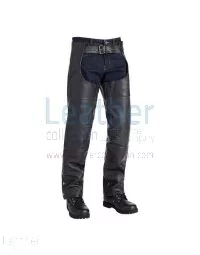
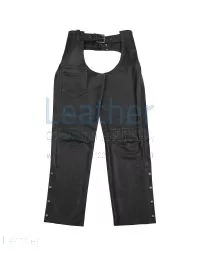
Style is also a real part of the choice. The page for lists an antique brown cowhide with a curvy, waist- and hip-hugging cut and thigh-lace adjusters, while are listed with a front buckle, back lacing and contrast piping. A different example is , whose page lists an adjustable front buckle belt, back lacing and partial-length side zippers with snaps. Details like these change the character of a cut. Detail choices are personal, but a rider should still check that decorative hardware does not sit where it could press into the leg.
What to wear with chaps
Chaps work as part of a full setup rather than on their own. Close-fitting pants underneath keep the leg line clean and reduce bunching. A jacket, gloves and boots that match the chaps in weight give the outfit a consistent feel, and a proper helmet remains the first piece of gear to buy. The origin of chaps in cowboy gear is why they pair naturally with boots, and the Wikipedia article on motorcycle protective equipment notes that leather chaps, adapted from cowboy gear, were used by American bikers starting in the early 1960s.
In cold or windy weather, the added leather layer cuts the wind on the thighs and shins. In hot weather the same layer can feel warm, which is one reason batwing cuts and perforated or lined options exist. Waterproofing is a separate question that depends on the finish, so ask rather than assume.
Care and storage
Leather care depends on the finish and construction, so the care label and the maker's instructions come first. A coated or finished leather may need a different approach from an oiled or distressed one. Follow the care label and the maker's instructions for drying and storage; if none came with the chaps, ask the maker. If a stain or odour is a concern, ask the maker which product suits that leather rather than applying a general treatment.
A short buying checklist
- Decide the use: cruising, commuting, cold-weather layering or style.
- Choose the cut: shotgun for a close fit, batwing for ease and airflow.
- Compare leather type, finish and any thickness information.
- Take measurements over the pants and boots that will be worn.
- Check the waist adjustment and zipper or snap design.
- Ask for documentation for any protection claim or armour option.
- Read the care label before cleaning or conditioning.
Frequently Asked Questions
Are motorcycle chaps worn over or instead of pants?
Chaps are worn over pants or jeans, not instead of them. They have no seat and are fastened at the waist with a belt or lacing, so they cover the legs only. Riders who want hip and seat coverage usually wear riding pants or a pair of leather pants and add chaps as an extra layer, mainly for wind and cold protection or for style.
What is the difference between shotgun and batwing chaps?
Shotgun chaps have straight, narrow legs and usually close with a zipper along the outside, giving a close fit. Batwing chaps have wide legs that flare below the knee, which allows more air circulation and makes them easier to put on over boots. The better choice depends on the riding position, the boots and personal preference.
Do leather chaps meet a motorcycle safety standard?
That depends on the specific item, and a buyer should not assume it. A standard such as EN 17092 sets test methods and classes for the garment types it covers, which SATRA names as jackets, pants and one- and two-piece suits. Chaps are not named there, so ask the seller whether any test documentation exists for the exact item and what it covers, and check the product page and order form for any armour option.
How should the waist of chaps fit?
The waist should fasten securely and stay in place when the rider sits and moves, without pressing uncomfortably. Adjustable lacing or buckles help because the position changes between standing and sitting. If the waist rides up or gaps at the back, the size or cut probably does not suit the rider. Try the chaps over the pants that will be worn underneath.
How do I clean and store leather chaps?
Start with the care label and the manufacturer instructions, because the right product depends on the leather finish and construction. Follow the maker's instructions for drying and storage, and ask the maker if none came with the chaps or if you are unsure about a specific product.
Written by the Leather Collection Editorial Team.