 USA
USA  Brazil
  Germany
  France
  Italy
Italy  Switzerland
  Sweden
  Spain
Spain  Great Britain
  Norway
  Russia
  South Africa
  Japan
Japan  New Zealand
  Australia
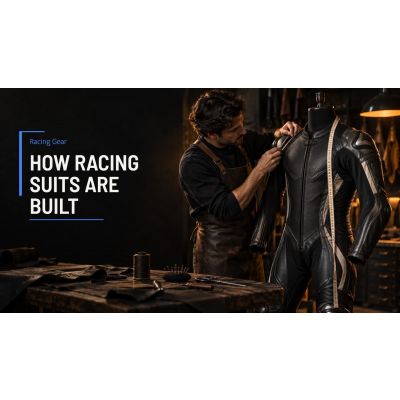
A MotoGP racing suit is a one-piece suit tailored to the rider, with inbuilt protectors for the knees, coccyx, shoulders, back, elbows and forearms (MotoGP.com). A MotoGP-inspired suit takes cues from that design, such as colours and layout, and is made for everyday riders and fans. Knowing how the original is constructed, and how a MotoGP-style suit should be measured, helps a buyer judge what a given suit offers and which size to choose.
Key Takeaways
- Factory MotoGP suits are tailored to one rider; a MotoGP-style suit is a separate product made to the buyer's measurements.
- Pro-level suits carry built-in protectors and airbag systems; a MotoGP-style suit should be checked for its own protection options.
- Fit in the riding position matters more than fit while standing.
- Always read the product page, size chart and armour options, and ask for documentation before ordering.
What a MotoGP racing suit actually is
The suits seen on the grid are one-piece leather garments. According to MotoGP.com, each rider's suit is tailored by manufacturers such as Alpinestars and Dainese, so the protective components sit in the right place, and it has inbuilt protectors for the knees, coccyx, shoulders, back, elbows and forearms. The same article confirms that the airbag suit worn by riders has airbags built into it.
Since the 2018 season, airbag-equipped suits have been compulsory for permanent riders in all classes of the MotoGP World Championship, with wild-card riders and replacement riders in their first two events excepted (Crash.net). The FIM later widened the rule: in October 2021 it announced that airbags would be compulsory in all FIM Sprint Circuit Racing championships from 2022 (FIM). That is one of the biggest differences between a works suit and a street-oriented suit, so it is worth keeping in mind when comparing the two.
What a MotoGP-style suit is, and what it is not
A MotoGP-inspired suit takes cues from a rider's suit, such as colours and layout, but it is a separate product made for a different buyer. It is not the rider's own suit, and it has no connection to any rider, team or championship. Browsing the collection groups racing suits in this style.
Many buyers want a suit for track days, others for display or for a style they like on the road. Those purposes lead to different priorities: a track rider needs a close, riding-position fit and protection options; someone buying a suit as a collectible cares more about livery accuracy. Deciding this first makes every later choice simpler. An individual design, such as this , lists on its product page the livery colours, leather options, armour options and sizing choices to compare before ordering.
How leather race suits are built
Panels and stitching
A race suit is cut from many panels rather than a few large pieces. Separate panels let the maker shape the suit for a crouched body, with extra room across the back and shoulders and pre-curved sleeves and legs. Where panels meet, seams are stitched, and seam strength is one of the things the garment standard EN 17092 assesses: SATRA notes that each seam type, zip fastener and protector pocket seam must be evaluated (SATRA).
Protector pockets and stretch zones
Protectors sit in pockets sewn into the lining at the knees, hips, shoulders and elbows, with a separate pocket or insert for the back. Stretch panels behind the knees, at the lower back and under the arms let the suit flex in the riding position. These details are common to the category, but each maker builds them differently, so the product page is the place to check what a specific suit includes.
Made to measure
Leather Collection race suits are made to order. The product pages list standard sizes and a Custom Size option, with measurements submitted after ordering, and show the armour and add-on options for each suit (see the shop's made-to-measure page). Browse the full range of to compare one-piece and two-piece designs.
Protection and standards: what the labels mean
EN 17092 is the European standard for protective motorcycle clothing. SATRA describes it as covering jackets, pants and one- and two-piece suits, with five classes: AAA, AA, A, B and C. Part 1 sets out the test methods and parts 2 to 6 give the requirements for each class. Impact protectors at the elbow, shoulder, knee and hip are mandatory in Class AAA and AA garments, while hip protectors are optional in Class A (SATRA).
A standard describes what a tested garment must achieve. It says nothing about a particular replica suit unless the maker supplies documentation for that suit. A buyer interested in protection should check the armour and add-on options listed on the product page, and ask for the documentation that applies to the exact suit and armour selected.
How to size a MotoGP-style race suit
A suit that feels right standing in a mirror can be wrong on the bike. Because the garment is cut for a crouched position, it should feel snug rather than loose when standing, since the leather stretches and moves into place when the rider tucks in. Measure the body, not an old jacket, and compare the numbers with the size chart on the product page.
| Measurement | How to take it | Why it matters |
|---|---|---|
| Height | Barefoot, standing straight against a wall | Sets overall suit length and torso length |
| Chest | Around the chest at its widest point, standing straight and breathing normally | Controls shoulder and upper body fit |
| Waist | About 5 cm below the navel, during normal breathing, with a relaxed abdomen | Affects the middle of the suit and ease of tucking in |
| Hips | Around the widest point of the hips | Needed for the seat and hip protector position |
| Inseam | Highest point in the crotch down to just above the ankle bone | Sets leg length so the knee protectors land on the knees |
| Arm length | Shoulder point to wrist, arm slightly bent | Keeps sleeves from riding up on the bars |
If your measurements fall between sizes, or one dimension differs a lot from the others, ask whether custom sizing is available before ordering. Protectors only work where they are positioned, so a suit that shifts on the body is a fit problem as well as a comfort problem. For a two-piece alternative, the product page of the lists a two-piece configuration.
Gloves and the rest of the kit
A suit is only part of a riding outfit. Gloves, boots and a back protector complete it, and the range is a natural next step once the suit is chosen. Gloves have their own standard, EN 13594, so the same rule applies: ask for the documentation for the exact item.
Before you order
Decide the purpose first, take the measurements twice, read the product page and its armour options, and ask questions before placing the order. A made-to-order suit rewards a careful brief.
Frequently Asked Questions
What is a MotoGP racing suit made of?
MotoGP.com describes the suits as tailored to each rider by manufacturers such as Alpinestars and Dainese, with built-in protectors at the knees, coccyx, shoulders, back, elbows and forearms. MotoGP-style suits take cues from the look. Check each product page for the material, lining and armour option of the exact suit.
Is a MotoGP-style suit the same as the one MotoGP riders wear?
No. A MotoGP-style suit takes cues from the colours and layout of a rider's suit, but it is a separate product, made for everyday riders and fans. It is not the rider's own suit and has no link to any rider or team.
What does EN 17092 AAA mean?
EN 17092 is the European standard for protective motorcycle clothing, with classes AAA, AA, A, B and C. SATRA lists impact protectors at the elbow, shoulder, knee and hip as mandatory for Class AAA and AA. Whether a specific suit meets it depends on that suit's documentation.
How should a race suit fit?
It should feel snug when standing, because it is cut for a crouched riding position. The protectors should sit over the knees, hips, elbows and shoulders without shifting. Take body measurements, compare them with the size chart, and ask about custom sizing if you fall between sizes.
Written by the Leather Collection Editorial Team.