 USA
 Brazil
 Germany
 France
 Italy
 Switzerland
 Sweden
 Spain
 Great Britain
 Norway
 Russia
 South Africa
 Japan
 New Zealand
 Australia

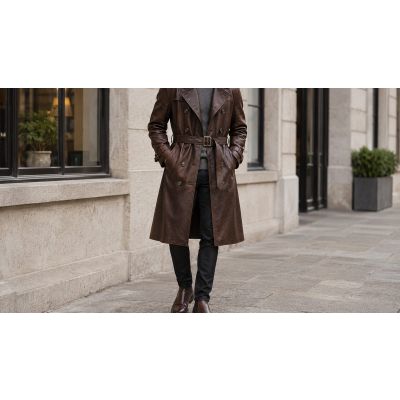
Short answer: wear a leather trench coat at about knee length, keep the layers under it slim, and choose simple shoes in a dark tone. Let the coat be the statement piece. Dark tailored trousers, a fine knit or a shirt, and leather boots or clean loafers cover almost every situation from the office to a weekend walk.
A leather trench is heavier and stiffer than a cotton one. It does not drape, it holds a shape. That is the reason it looks so good when the proportions are right and so awkward when they are not. The sections below go through length, layers, shoes and details in the order that matters most. If you are still deciding which coat to buy, read our guide to choosing a men's leather trench coat for daily use first.
Length first: where the hem should land
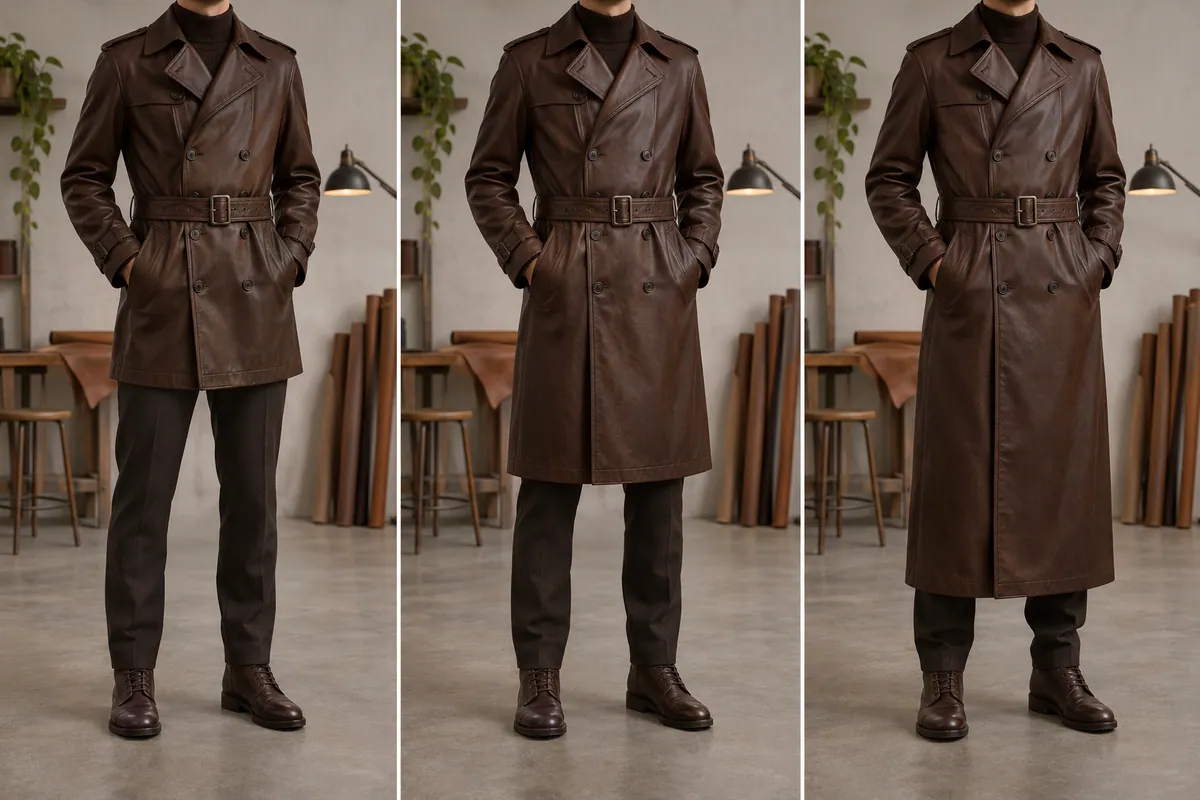
Length decides more about the outfit than color or belt. Leather does not swing and fall the way wool does, so a hem that is a few inches off changes the whole silhouette.
| Hem position | What it looks like | Best for |
|---|---|---|
| Above the knee (mid-thigh) | Sharper and more casual, closer to a long jacket | Shorter men, jeans and boots, motorcycle-adjacent looks |
| At the knee or just below | The classic trench proportion, balanced with a suit or trousers | Most heights, office and city wear |
| Mid-calf | Dramatic and long; reads as a statement coat | Taller men, slim dark outfits, cold weather |
Check the length in front of a mirror with your arms relaxed and with a jacket or knit already on. If the coat hits the widest part of your calf, it will visually shorten your legs. If it ends well above your fingertips, it will look like a jacket that wandered off. Shorter men usually do better at or just above the knee. Tall men can carry mid-calf. A coat cut to your height is the simplest way to avoid guessing, which is one reason people look at custom trench coats, which are made to your measurements.
What to wear underneath
Leather has very little stretch. Whatever you put under the coat has to fit into the same space, so think in thin layers.
- Suit or blazer: works if the coat has enough room across the back and upper arms. Try the coat with the jacket on before you buy. A trim tailored jacket usually fits; a padded, boxy one will not.
- Fine knit or merino: the easiest option. A crew or roll neck in charcoal, navy or cream sits flat and keeps the collar line clean.
- Shirt and tie: good for formal days. Keep the collar small enough that it does not fight with the coat collar.
- Hoodie: possible only with a coat that was sized for it. Pick a thin hoodie and let the hood lie outside the coat collar, or skip it.
The sleeves are where people notice a layering problem first. If a knit bunches at the elbow when you bend your arm, the coat is too tight for that layer. See the fit checklist near the end.
Shoes that work
A long dark coat is a strong shape, so shoes should be quiet. Match the formality of the shoe to the rest of the outfit rather than to the coat.
- Chelsea or lace-up leather boots: the most reliable choice. Black with a black coat, dark brown with brown or tan.
- Loafers or derby shoes: best with a suit or tailored trousers, and best when the hem is at the knee or above so the shoe is visible.
- Clean leather sneakers: fine for weekends with dark jeans. White or grey, minimal branding, no chunky soles under a long coat.
Office and formal looks
Treat the coat as outerwear, not as part of the suit. A charcoal or navy suit, a white or pale blue shirt and black leather shoes look right under a black or dark brown trench. Keep the colors close in tone. A black coat over a brown suit pulls attention in two directions.
If you do not want a full suit, a leather blazer under a leather trench is too much leather in one outfit for most people. Use cloth under it instead.
Casual and weekend looks
Dark jeans, a grey or black knit and boots is the easiest weekend outfit. Add a plain scarf in wool or cashmere when it is cold. Avoid graphic T-shirts and bright sneakers, which fight with the formal structure of the coat. For a lighter version, wear the coat open over a T-shirt and chinos, and let it hang without a belt.
Belt, collar and sleeve details
- Belted: adds shape and suits a slimmer frame. Tie it in a simple knot or buckle it; do not cinch hard, because leather creases at the waist.
- Open or loose belt: more relaxed and better for broader builds. Tie the belt behind the back or loop it so it does not hang.
- Collar: up in wind or for a sharper look, down for daily wear. A stiff leather collar keeps its shape either way.
- Cuffs: a little shirt cuff showing past the coat sleeve looks deliberate. Sleeves that end at the knuckle are too short.
Colors and leather finish
Black is the easy default and works with nearly everything. Dark brown is softer and pairs well with navy, grey and olive. Matte or semi-matte finishes look more refined with tailoring; a high gloss reads more fashion-led and shows creases more. Lighter colors such as sand look good on tall men but need a calmer outfit around them. Leather can be ordered in any color on request. Check men's leather coats for what is currently offered.
Fit checklist before you wear it out
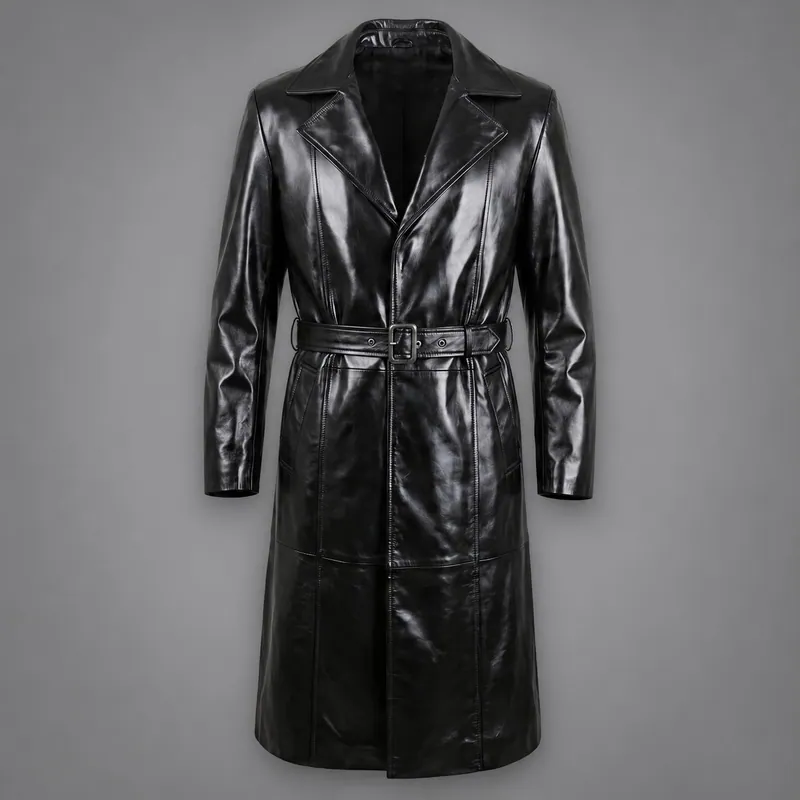
- Shoulders: the seam sits at the edge of your shoulder bone. If it droops, the coat is too big; if it pulls across the back, too small.
- Chest and back: you can button the coat over your normal winter layer without pulling at the button.
- Sleeve length: the cuff ends at the wrist bone or just past it when your arms hang.
- Arm movement: raise both arms to shoulder height. The hem should not ride up past the hip.
- Length: confirm the hem in the mirror and while sitting. A coat that bunches on a chair is too long for you, so choose a shorter length. We do not alter garments after delivery.
Our size chart shows how to measure. For a coat that must fit over a suit, measure while wearing the thickest layer you plan to use. For more on why leather coats keep returning to the wardrobe, see the enduring style of leather coats.
Common mistakes
- Buying for the thin shirt you try it on in, then adding a jumper later.
- Wearing a hem that stops at the widest point of the calf.
- Mixing a glossy coat with a very casual graphic outfit.
- Cinching the belt tight, which leaves permanent creases.
FAQs
What length should a men's leather trench coat be?
Around the knee is the safest length. Shorter men can go a hand's width above the knee, and taller men can wear mid-calf. Avoid a hem that ends at the widest part of the calf.
Can you wear a leather trench coat with a suit?
Yes, if the coat has enough room in the shoulders and upper arms for the suit jacket. Try it on with the jacket and choose a coat in a similar tone to the suit.
Should a trench coat be belted?
Either works. A belted coat gives more shape on slim builds; an open or loosely tied coat looks more relaxed. Avoid pulling the belt very tight, since leather creases at the waist.
What shoes go with a leather trench coat?
Leather boots are the most reliable. Loafers or derby shoes suit tailoring, and clean leather sneakers work with dark jeans on weekends.
Is a leather trench coat too dressy for casual wear?
No. Wear it open over a T-shirt or knit with dark jeans and boots, and skip the belt. The coat reads casual when the layers under it are casual.
How should a leather trench coat fit in the shoulders?
The shoulder seam should sit at the edge of the shoulder bone, with no pulling across the back when you reach forward. Leather will not stretch much, so a tight shoulder will stay tight.
If you want length, sleeves and layering room set for your own build, see our custom trench coats.