 USA
USA  Brazil
  Germany
  France
  Italy
Italy  Switzerland
  Sweden
  Spain
Spain  Great Britain
  Norway
  Russia
  South Africa
  Japan
Japan  New Zealand
  Australia
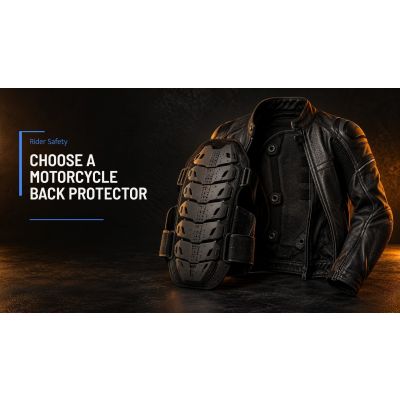
A back protector is worth considering for many riders, because the spine is a part of the body where injuries can be serious. EN 1621-2 is the European standard that tests motorcycle back protectors, and it is the reference point for comparing them. This guide explains what the standard measures, what Level 1 and Level 2 mean, and how to decide whether you need one.
Key Takeaways
- EN 1621-2 is the impact standard for motorcycle back protectors, with two performance levels.
- Level 2 allows less transmitted force than Level 1, so a lower number means more of the impact is absorbed.
- The standard covers full back, central back and lower back (lumbar) protectors.
- A protector reduces impact force, but it does not prevent every kind of back injury.
- Check the product page for any armour it lists, and ask for the documentation.
What EN 1621-2 covers
EN 1621-2 was written specifically for back and lumbar protectors. It follows a test method similar to EN 1621-1, the standard for limb protectors such as shoulder, elbow and knee armour, but, according to SATRA, it uses a different anvil and striker geometry. According to SATRA, the standard recognizes three types: full back, central back and lower back (lumbar) protectors.
In the test, an impact is applied to the protector and the force transmitted through it is measured. A protector that transmits less force is considered to perform better. Mandatory impacts are carried out after ambient and hydrolytic aging conditions, and extra tests at high and low temperatures are optional.
Level 1 vs Level 2 figures
The standard sets two performance levels. For Level 1, the mean peak force recorded below the anvil must be below 18 kN, and no single value may exceed 24 kN. For Level 2, the mean must be below 9 kN and no single value may exceed 12 kN, as summarized by Wikipedia. SATRA lists the Level 1 figures on its EN 1621 page.
| Level | Mean transmitted force | Highest single value |
|---|---|---|
| Level 1 | Below 18 kN | No more than 24 kN |
| Level 2 | Below 9 kN | No more than 12 kN |
These numbers describe a laboratory test on the protector alone. They do not predict how much protection a rider gets in a real crash, where the impact direction, speed and fit all vary.
Do you need a back protector?
Whether a back protector is required depends on where and how you ride, and on the rules of any track, event or insurer involved. Those rules change, so check the current ones for your situation rather than relying on a general guide.
Beyond rules, the question is one of risk. The spine is a part of the body where injuries can be serious, and the protector is one of the few pieces of gear aimed at it directly. Many riders who wear a jacket or suit with removable armour add a back protector for that reason. Riders who commute, tour or ride on track all face an impact risk, though the type of crash differs.
What a protector cannot do
Research is more cautious than marketing. A 2016 systematic review summarized on Wikipedia notes that back protectors are unable to protect against most spinal injuries, which are caused by bending and torsional forces. A protector is one layer of a riding kit, not a replacement for skill, speed judgment and good judgment about conditions.
Fit and garment choice
A protector only works if it stays over the area it is meant to cover. A loose fit, an incorrect size or a pocket that lets the protector slide can move it away from the spine. Check that the protector type (full back, central back or lower back) matches the area it is meant to cover, and that it stays over the spine when you bend into a riding position.
Many jackets and suits have a back pocket or accept an insert. Browse motorcycle jackets or the range, or the and collections, and check each product page for the armour it lists; ask for the documentation that applies before ordering. A back-support panel sold for comfort is a different thing from a back protector.
How to check before you buy
- Look for a clear reference to EN 1621-2 on the protector itself, not only on the garment description.
- Check the level (1 or 2) and the type: full back, central back or lower back.
- Confirm the size or length suits your height and the garment.
- Ask for the documentation that applies to the armour option you select.
Do not assume that a garment includes a specific armour level because of a general description. Confirm the armour listed for the exact item before ordering.
Frequently Asked Questions
Is a back protector required by law?
Rules differ by country and region, and they change, so this guide does not state a legal requirement. Check the rules of the place where you ride and of any track or event you attend. Track-day organizers and race series often set their own gear rules, and those are published in their entry regulations.
What is the difference between EN 1621-2 Level 1 and Level 2?
Both levels use the same impact test, but Level 2 allows less force to pass through the protector. Level 1 requires a mean below 18 kN with no single value over 24 kN. Level 2 requires a mean below 9 kN with no single value over 12 kN.
Does a back protector replace a foam pad in a jacket?
They are different things. Plain foam padding sold as comfort lining is not the same as a back protector assessed under EN 1621-2. If a jacket or suit lists a back protector, check the product page for the armour it lists and ask for the documentation that applies to it.
Can a back protector prevent all spinal injuries?
No. A protector is designed to reduce the force from a direct impact, not to stop every kind of spinal injury. A 2016 review summarized on Wikipedia notes that back protectors are unable to protect against most spinal injuries, which are caused by bending and torsional forces. Gear, riding skill and conditions all matter.
Written by the Leather Collection Editorial Team.