 USA
USA  Brazil
  Germany
  France
  Italy
Italy  Switzerland
  Sweden
  Spain
Spain  Great Britain
  Norway
  Russia
  South Africa
  Japan
Japan  New Zealand
  Australia
A custom driving glove is worth ordering when stock sizes leave the fingers too long, the palm too loose or the lining wrong for the car and the climate. The three decisions that matter are the leather, the lining (or the choice to have none) and the fit, and they affect each other: a thin skin with no lining gives the most feel at the wheel, while a thicker skin or a warm lining trades some of that feel for comfort in cold weather.
This guide explains how each choice changes the way a glove behaves, what to measure before ordering, and what to ask a maker. It covers road driving gloves; gloves for motorcycles and for motorsport have different requirements and are mentioned only where the difference helps.
Key Takeaways
- Traditional driving gloves are made of thin, soft leather and are usually unlined, so the hand keeps a clear feel of the wheel.
- Lambskin, cowhide and goatskin behave differently: thinner skins feel softer, thicker hides feel sturdier.
- A lining adds warmth but also thickness, so the size should be chosen with the lining in mind.
- A driving glove should fit snugly without restricting finger movement; measure the hand before ordering.
- Follow the care label of the finished glove, because the right care depends on the leather and its finish.
What makes a driving glove different from a standard glove
According to Wikipedia's entry on driving gloves, a driving glove is typically a covering of very thin, soft leather meant to improve grip on the steering wheel and gear lever. The same source notes that driving gloves first appeared in the 1890s, when wheels were bare wood or metal, and that classic designs are unlined with external seams, short cuffs and a stud fastener at the wrist. Some versions have open knuckles or ventilation holes in the fingers and palm.
Each of those details is a choice that a custom order can change. Seams on the outside keep bulk off the fingertips. A short cuff stays clear of the sleeve and the wrist when turning the wheel. A closure at the wrist lets the glove be tightened without a bulky strap. When these features are fixed in a ready-made glove, the only variable left is size; with made-to-measure orders, check with the maker which details can be changed.
Leather choices for driving gloves
Wikipedia's overview of glove materials and linings lists lambskin, cowhide, deerskin, goatskin and sheepskin among the skins used for leather gloves. For driving, the practical difference is thickness and surface feel rather than a ranking.
Lambskin
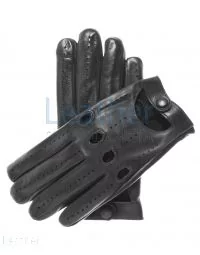
Lambskin is usually thin and soft, which is why it is a common choice when feel at the wheel matters most. A pair such as these shows a men's unlined driving style with vent holes; check the page for the exact leather. In general, a thinner skin is less forgiving of rough handling.
Cowhide
Cowhide is generally thicker and firmer than lamb. In a driving glove it tends to feel sturdier and may need a short break-in period before it moulds to the hand. It is worth considering for drivers who prefer a more substantial glove or who also wear them for other tasks.
Goatskin and other skins
Wikipedia describes goatskin as hard-wearing but coarser than other glove leathers. Deerskin and sheepskin are also used. Because thickness varies by tannery and finish, the practical step is to ask the maker for the leather's thickness and finish, and to request a swatch or description rather than rely on the animal name alone.
Lining: unlined, silk, wool or cashmere
Unlined is the classic driving construction and gives the thinnest feel. Linings are added for warmth. Wikipedia's glove overview describes cashmere as warm, light and comfortable, silk as warm in winter and cool in summer, and wool as naturally warm and elastic, with wool blends and acrylics also used.
Choosing a lining changes the fit. A lining takes up space inside the finger, so a glove that fits snugly when unlined may feel tight once lined, and the reverse can be true if the lining packs down with wear. When ordering a lined pair, say which lining is wanted and ask whether the size chart already allows for it. Drivers in mild climates often keep a thin unlined pair; those in cold winters may order a lined pair for the cold months.
| Choice | Typical effect | Worth asking the maker |
|---|---|---|
| Thin leather, unlined | Most feel at the wheel | Seam position and thickness of the leather |
| Thicker leather, unlined | Sturdier, may need break-in | How the leather softens with use |
| Silk lining | Light added warmth | Whether the sizing allows for the lining |
| Wool or cashmere lining | Warmer, thicker | Whether to order a half size larger |
Getting the fit right
Wikipedia's driving glove entry says a driving glove should be worn snugly and should not interfere with hand movement. Racing versions are described as tight at the wrist or cuff. For road use that means no loose leather at the fingertips, no pulling across the knuckles and a wrist closure that can be fastened without force.
- Measure around the widest part of the hand (excluding the thumb), as the maker's size guide describes.
- Measure the length of the longest finger from the tip to the base where it meets the palm.
- Measure both hands and note any difference between them.
- Compare these figures with the maker's own chart, because size systems vary between makers.
- Note any special request, such as shorter fingers, a longer cuff or a different closure, in the order notes.
A custom order is most useful when the hands fall between standard sizes or when the fingers are unusually long or short. If a size looks borderline, follow the maker's size guide (the shop suggests considering the bigger size between two sizes) and ask before ordering.
Men's and women's styles
Driving gloves are sold in both men's and women's cuts, and the difference is mostly in the pattern: finger length, palm width and cuff shape. Shoppers can browse the for the men's range or the for the women's range. Hands do not always follow the labels, so measurements should drive the choice rather than the department.
Care and what to ask before ordering
Care depends on the leather and its finish, so the garment's care label and the maker's instructions are the reference. Gloves that get wet or sweaty are usually left to dry naturally away from direct heat, but check the instructions that come with the pair. Before ordering, ask the maker:
- Which leather is used, and how thick it is.
- Whether a lining is available and how it affects sizing.
- Where the seams sit, and whether the closure can be changed.
- How measurements are taken and whether a remake is possible if the fit is off.
Frequently Asked Questions
Should driving gloves be lined or unlined?
Classic driving gloves are unlined, which keeps the leather thin and maximizes feel at the wheel. A lining adds warmth and some bulk. Drivers who spend winters in cold cars often choose lined pairs, while those who drive in mild weather usually prefer unlined. If ordering lined gloves, ask whether the size chart already allows for the lining thickness.
Which leather feels softest for driving?
Thin leathers such as lambskin are generally the softest and give the most feel, but softness depends on the tannery, thickness and finish as much as on the animal. Cowhide is usually firmer, and goatskin is described as hard-wearing but coarser. Ask the maker for the leather's thickness and finish, and request a description or swatch where possible.
How snug should a driving glove be?
A driving glove should fit snugly without restricting finger movement or pulling across the knuckles. Loose leather at the fingertips reduces grip and feel. The wrist closure should fasten without force. Check the maker's size guide if the measurement falls between two sizes.
Can I wear motorcycle gloves for driving, or driving gloves for riding?
They are built for different jobs. Driving gloves are thin and light so the hand can feel the wheel, while motorcycle gloves are designed with riding protection in mind. Driving gloves should not be treated as a substitute for riding gloves, and the maker's product description should be checked for the intended use.
Written by the Leather Collection Editorial Team.